Cybersecurity for Edmonton construction companies is no longer a back-office problem. Bid data, project files, jobsite connectivity, and payment workflows are now actively targeted, and the construction sector sits among the most attacked verticals in Canada.
Most construction firms in Edmonton historically ran lean IT. A small head office, a handful of estimators and project managers, a few servers, and a lot of laptops bouncing between trailers, vehicles, and the office. That model worked when threats focused on financial services and healthcare. It does not work in 2026. General contractors are starting to require cybersecurity attestations from subs. Owners and sureties are starting to ask about controls during pre-qualification. Cyber insurance brokers are starting to refuse coverage for unprotected construction firms after several public ransomware events in the sector.
This guide walks through what cybersecurity for a construction company in Edmonton actually involves in 2026, the threats that target the industry specifically, where the real exposures sit (head office, project trailers, BIM and PM platforms, payment workflows), and what a workable security posture costs for a typical 50-person firm.
Why construction is different
Construction has a distinctive IT footprint relative to other small businesses of similar size. Five characteristics drive the threat profile.
- High-value transactional workflows: tender submissions, change orders, progress draws, supplier payments. Each one is a potential fraud target.
- Distributed work environment: jobsite trailers, vehicle laptops, contractor BYOD, and head office, all sharing data.
- Heavy reliance on third-party platforms: Sage, Procore, Acumatica, Autodesk Construction Cloud, Bluebeam, Plan Grid. Each is an external account surface.
- Long project timelines: a compromised supplier identity can persist for months across a project before being caught.
- Lean internal IT: many firms run with one or two internal IT staff supporting the entire operation, often part-time.
The combination of high-value transactions, distributed devices, lots of external accounts, and lean internal IT is the same profile that drives high ransomware and fraud incidence in the sector.
The threats that target construction specifically
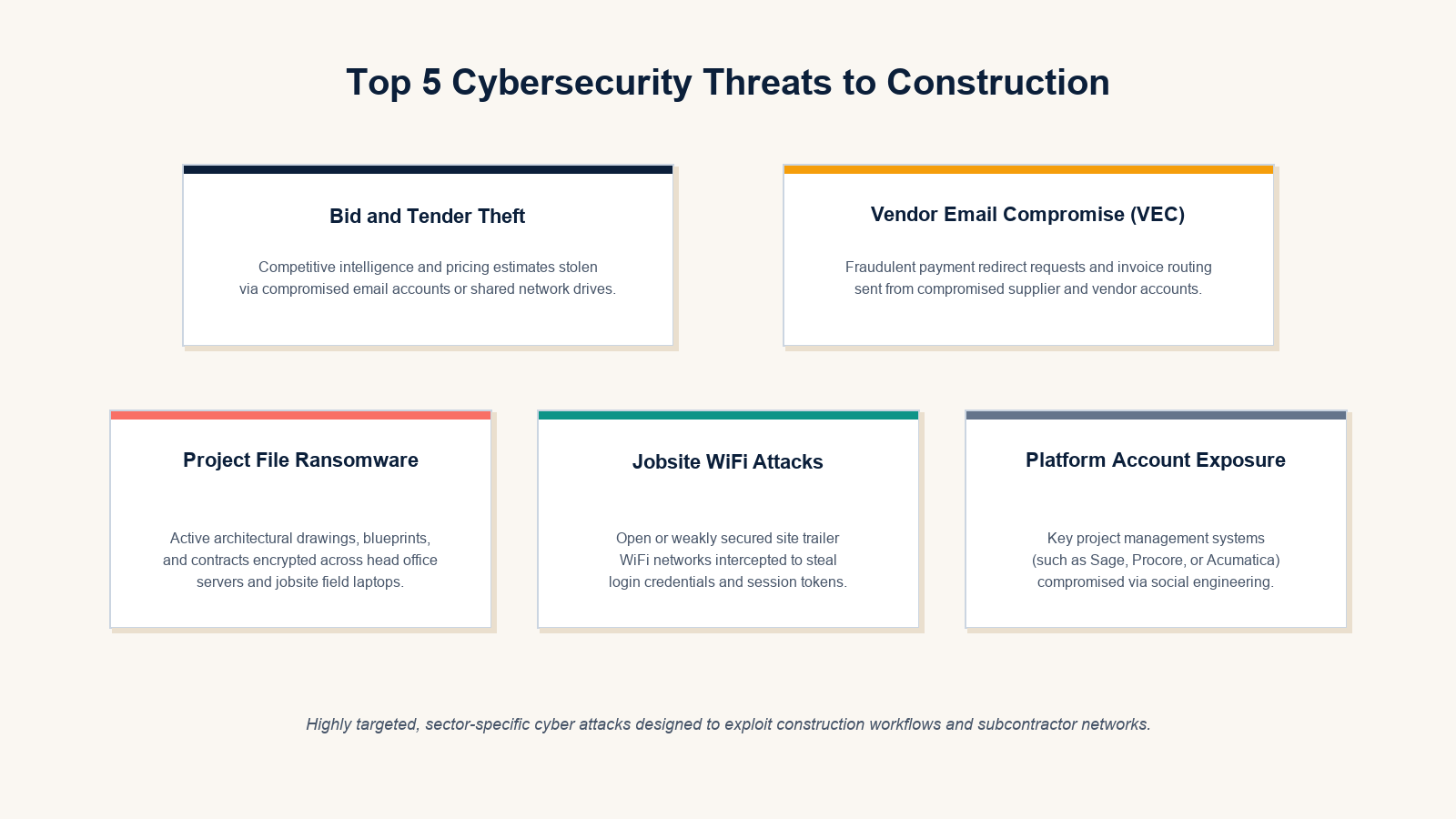
Bid and tender theft
Competitive bid data is valuable. Attackers who gain access to an estimator’s mailbox or a shared bid folder can sell or use the information directly. Losses are often not detected until a pattern of lost bids on tight margins emerges.
Vendor email compromise and payment redirect fraud
A supplier’s email is compromised. The attacker waits for an invoice cycle, then sends a payment instruction change from the supplier’s real domain. The construction firm wires the next progress payment to the attacker’s account. Losses in the six-figure range are not uncommon in this scenario. Controls are non-technical as much as technical: out-of-band verification of payment changes, supplier portal use over email instructions, and finance team training.
Project file ransomware
Drawings, contracts, change orders, project schedules. All encrypted at once. Operations stall because no one can pull the current revision of a drawing, schedule, or contract. The dependency on shared file repositories means even small construction firms can lose a week or more of operational capacity to a single ransomware event.
Jobsite WiFi attacks
Site trailers often run open or weakly secured WiFi, sometimes consumer-grade routers handed over by a previous project, sometimes a contractor’s hotspot. Devices that connect to head office over those networks bring traffic into the corporate environment. Where head office and jobsite WiFi share credentials or VPN paths, the exposure compounds.
Project management platform exposure
Procore, Sage, Acumatica, Autodesk Construction Cloud accounts are targeted with phishing, OAuth consent abuse, and credential reuse. Once inside, attackers can exfiltrate contracts, modify documents, or redirect notifications. Many small firms enable MFA on Microsoft 365 but never tighten the configuration of the construction platforms themselves.
What a workable posture looks like
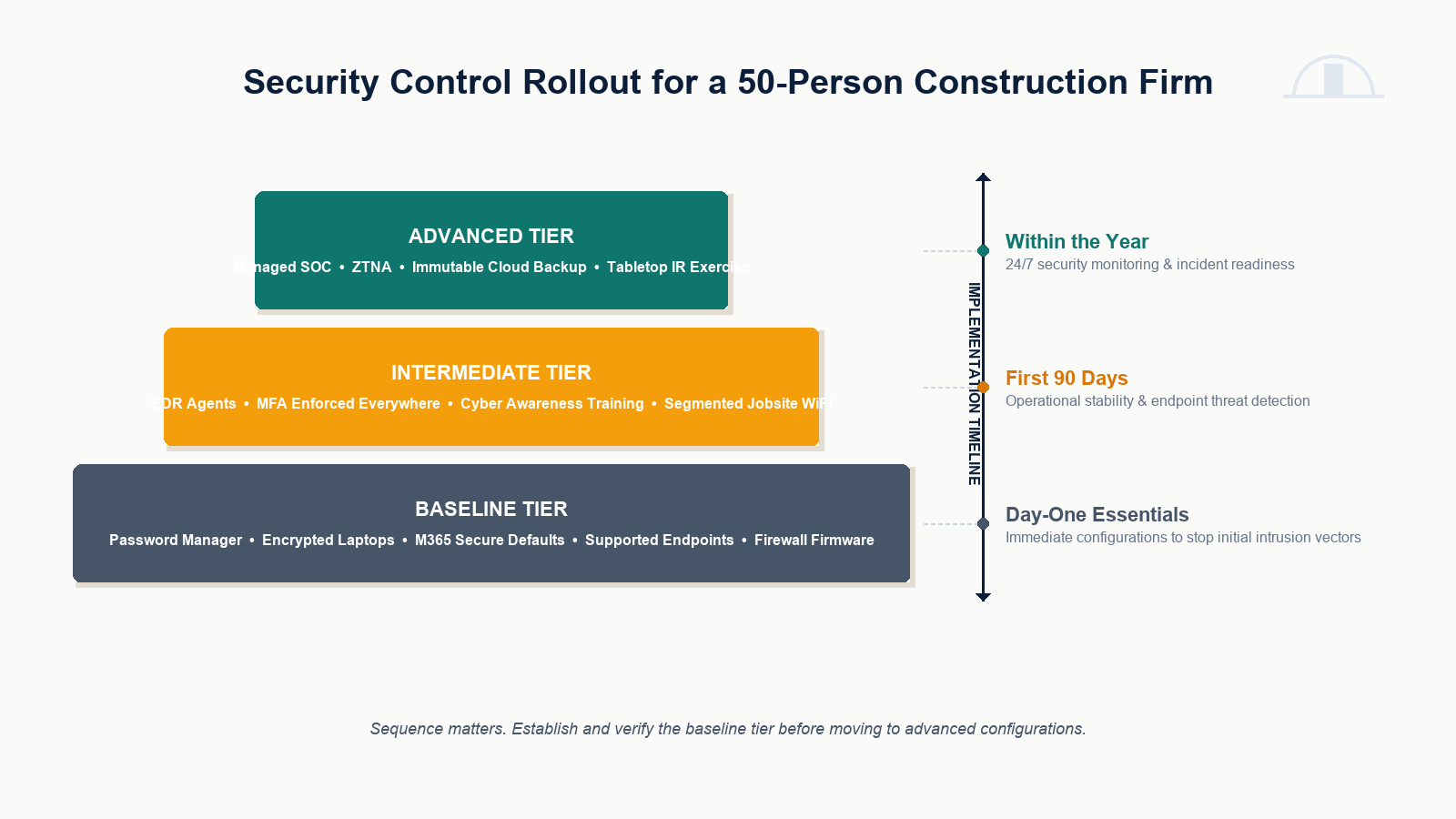
A working cybersecurity posture for a typical 50-person Edmonton construction firm has three tiers, sequenced over the first year.
Baseline (day-one essentials)
Password manager rolled out to all staff. Full-disk encryption on every laptop. Microsoft 365 secure defaults enabled. All endpoints on supported operating systems and patch SLAs. Current firmware on the head office firewall. Documented offboarding procedure that disables accounts and revokes platform access on the day of separation.
Intermediate (first 90 days)
EDR deployed on every workstation, laptop, and server. MFA enforced everywhere, including the construction platforms and not just M365. Security awareness training program with phishing simulation, with focus on payment redirect fraud scenarios for finance and PMs. Jobsite WiFi standardized: a managed access point per trailer with a separate SSID for site staff, a guest SSID isolated from the company VPN, and no shared credentials with head office.
Advanced (within the year)
Managed SOC or MDR providing 24×7 monitoring and response. Zero Trust Network Access replacing or supplementing VPN for remote access. Immutable cloud backup for Microsoft 365, file shares, and key construction platforms (where the platform supports export). Annual tabletop exercise with the leadership team in the room, including a vendor-email-compromise scenario.
What it usually costs
For a 50-person construction firm in Edmonton, the baseline tier is typically a small share of overall IT spend, often well within an existing managed services arrangement. The intermediate tier adds modest per-user monthly cost for EDR, training, and improved jobsite WiFi. The advanced tier adds managed SOC pricing (per-endpoint or per-user monthly), ZTNA platform cost, and immutable backup cost.
The total typically lands well below the cost of a single significant incident. The framing that lands with most construction owners is straightforward: this is roughly the cost of one mid-sized progress payment per year, in exchange for materially reducing the chance of losing several to fraud or ransomware.
What construction firms usually get wrong
Three patterns appear repeatedly in our assessments of Edmonton construction firms.
The first is treating jobsite WiFi as a separate problem from corporate security. Once a head-office laptop joins a weakly secured site network, the site has become part of the corporate attack surface. Jobsite WiFi has to be designed deliberately, not improvised per project.
The second is securing Microsoft 365 thoroughly and leaving the construction platforms alone. Procore, Sage, Acumatica, and Autodesk accounts are valuable in their own right and frequently lack MFA, conditional access, or session monitoring even in firms where M365 is well configured.
The third is no out-of-band payment verification process. Wire transfer changes, supplier banking updates, and large invoice approvals all need a documented out-of-band verification step. This single non-technical control prevents most vendor-email-compromise fraud cases regardless of the technical posture around it.
FAQ
Why is construction such a frequent target?
High-value transactions, distributed workforce, third-party platform reliance, and historically lean IT staffing. The risk-to-reward ratio for attackers is favourable, which drives focus on the sector.
Do we need to secure jobsite WiFi if we have a VPN?
Yes. A VPN protects the traffic destined for head office. It does not protect the device itself from attacks on the local network, and it does not prevent devices from interacting with whatever else is on the open trailer WiFi.
Are GCs really starting to require cybersecurity attestations?
Increasingly yes, particularly on public sector and large institutional projects. Pre-qualification questionnaires now include cybersecurity controls more often than they did even two years ago.
What about BYOD on site?
Personal devices that access corporate data should be enrolled in management with at minimum a containerized work profile, MFA enforcement, encryption, and remote wipe. Otherwise access should be restricted to browser-only with no corporate data leaving the session.
What is the single highest-leverage control for a construction firm?
MFA enforced across every account that matters, including the construction platforms, paired with a written out-of-band payment verification process. Those two together address the largest categories of construction-sector loss.
If you are reviewing your security posture
Most construction firms in Edmonton already know where their weakest spots are: that one trailer with the old router, the supplier who keeps changing payment details by email, the estimator whose mailbox never had MFA enforced, the file share everyone touches with no backup discipline. A focused construction-sector assessment usually surfaces a short list of fixes that materially change the risk picture without disrupting projects in flight.
Our team works with Edmonton construction firms on jobsite WiFi standardization, construction platform security, payment fraud controls, and managed cybersecurity for distributed operations. Book a construction cybersecurity assessment for your firm. We will review your head office, your active jobsites, and your project platform footprint, and provide a prioritized roadmap you can execute through the construction season without slowing projects down.