“`html
Cisco Meraki solutions help businesses simplify network management, improve security, and reduce operational complexity with cloud-managed infrastructure that works for growing organizations.
Cisco Meraki deployments for Edmonton businesses in 2026 are becoming less about “nice to have centralized management” and more about operational survival. Hybrid work, rising ransomware attacks, remote branch offices, and growing compliance requirements have pushed many Alberta organizations away from traditional networking toward cloud-managed infrastructure that can actually be monitored and secured consistently.
If you are an IT manager, business owner, or operations director in Edmonton, chances are you have already experienced at least one of these problems in the last years:
- WiFi outages no one could diagnose remotely
- VPN complaints from remote employees
- Aging firewalls with expired support
- Multiple office locations managed separately
- No visibility into network performance
- Security gaps caused by inconsistent configurations
That is exactly where Cisco Meraki has gained traction across Edmonton businesses, professional services firms, healthcare clinics, warehouses, retail chains, and multi-site organizations.
Why businesses are moving to Cisco Meraki
Three things are driving Meraki adoption across organizations.
Firstly, IT teams are stretched thin
Many small and mid-sized businesses have one or two internal IT staff supporting everything: Microsoft 365, user support, printers, security, networking, remote workers, and cloud systems. Traditional networking environments require separate management interfaces, manual firmware updates, command-line troubleshooting, and inconsistent monitoring. Meraki centralizes these into a single dashboard accessible from anywhere. For businesses without a dedicated network engineer, this is a major operational advantage.
Secondly, hybrid work changed network requirements
Before 2020, most businesses designed networks around office-based users. That model is gone. Now organizations need secure remote VPN access, reliable wireless coverage, cloud application visibility, multi-site connectivity, centralized policy management, and faster troubleshooting. Cisco Meraki was designed around cloud-managed infrastructure from the beginning, which made it particularly effective for distributed environments.
Thirdly, cybersecurity expectations increased
Cyber insurance providers and compliance frameworks increasingly expect businesses to maintain secure remote access, network segmentation, multi-factor authentication, event logging, device visibility, firmware patching, and guest WiFi isolation. Older unmanaged or partially managed networks often struggle to meet those expectations consistently. Meraki simplifies many of these controls through centralized security policies and automated management.
What Cisco Meraki actually includes
Many businesses think Meraki is “just WiFi.” It is much broader than that.
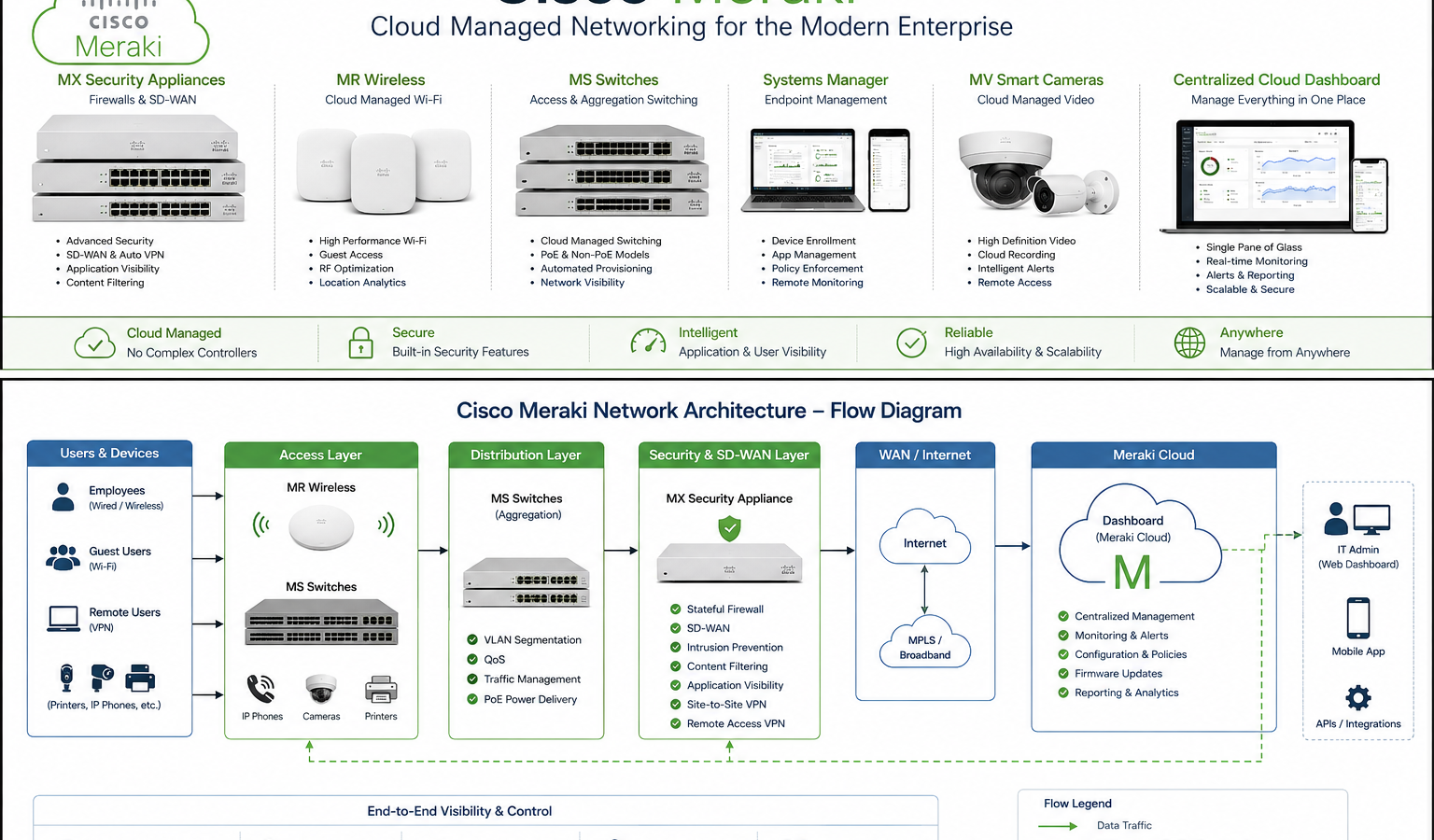
Meraki MX Security Appliances
These are cloud-managed firewalls and SD-WAN devices providing site-to-site VPN, remote VPN access, content filtering, intrusion detection and prevention, traffic shaping, application visibility, WAN failover, and security event logging. For businesses with multiple offices, the Auto VPN feature is one of the biggest advantages because branch offices can securely connect with minimal manual configuration.
Meraki MR Wireless Access Points
Enterprise wireless access points managed entirely through the dashboard. Key benefits include centralized WiFi management, guest WiFi isolation, usage analytics, fast roaming, remote troubleshooting, RF optimization, and security policy enforcement. We regularly see organizations replace aging consumer-grade wireless systems with Meraki and immediately reduce support tickets related to dropped connections and inconsistent coverage.
Meraki MS Switches
Cloud-managed switches with remote port configuration, VLAN management, PoE support for phones and APs, port monitoring, device identification, and automated alerts. For small IT teams, being able to remotely troubleshoot a switch port without driving across Edmonton is a major operational improvement.
Meraki Systems Manager
Endpoint and mobile device management integrated into the same ecosystem, allowing organizations to manage laptops, mobile devices, tablets, security policies, application deployment, and device compliance. For organizations already using Microsoft Intune, Meraki Systems Manager is not always necessary, but for smaller businesses wanting simpler management, it can be effective.
The cybersecurity advantage of Meraki
Meraki is not a complete cybersecurity solution by itself, but it significantly improves network security posture when configured properly.
Network visibility
One of the biggest problems during incidents is not knowing what devices exist on the network. Meraki provides visibility into connected devices, bandwidth usage, suspicious traffic, application usage, rogue access points, and failed login attempts. That visibility matters during both troubleshooting and security investigations.
Network segmentation
Many ransomware incidents spread laterally because internal networks are flat. Meraki makes segmentation easier by allowing businesses to separate guest WiFi, corporate devices, VoIP phones, security cameras, IoT devices, and server infrastructure. Segmentation limits the blast radius if a device becomes compromised.
Secure remote access
Remote VPN access remains one of the most targeted entry points for attackers. Meraki supports MFA integration, secure client VPN, identity-based policies, and centralized access control. For businesses still relying on outdated VPN appliances, upgrading remote access security is often one of the fastest risk reductions available.
What businesses usually get wrong
Three patterns appear repeatedly during network assessments.
Mixing enterprise and consumer hardware
A business may have one enterprise firewall, consumer WiFi routers, unmanaged switches, and random ISP equipment. The result is inconsistent security and almost impossible troubleshooting. Standardization matters more than most businesses realize.
Poor wireless design
Access points are often installed based on convenience instead of coverage planning. Common issues include too few access points, APs installed in poor locations, channel overlap, signal interference, and warehouse coverage gaps. Even good hardware performs poorly without proper design.
No monitoring or alerting
Many organizations only discover network issues after users complain. Meraki’s centralized alerts and monitoring reduce downtime significantly because problems are identified earlier.
What a typical deployment costs
For small and mid-sized businesses, a basic Meraki deployment cost usually depends on number of locations, firewall requirements, wireless coverage needs, licensing, switching infrastructure, and cabling requirements. Meraki licensing is subscription-based, which some organizations dislike initially, but it includes centralized cloud management, firmware updates, and ongoing platform access.
The real ROI
The biggest return usually comes from operational efficiency, not hardware savings. Organizations typically reduce troubleshooting time, on-site IT visits, network downtime, VPN complaints, wireless support tickets, and configuration inconsistencies. For businesses with small IT teams, those operational gains often justify the investment quickly.
FAQ
Is Cisco Meraki good for small businesses?
Yes. Meraki is widely used by small and mid-sized businesses because it simplifies management and reduces the need for advanced networking expertise internally.
Does Meraki require a network engineer?
Not necessarily. Basic management is significantly easier than traditional CLI-heavy networking environments, though proper design and deployment still benefit from experienced networking professionals.
Can Meraki replace traditional VPNs?
In many cases, yes. Meraki supports both remote access VPN and site-to-site VPN connectivity with centralized management.
Is Meraki secure enough for professional services firms?
When properly configured, yes. Many law firms, healthcare clinics, accounting firms, and financial organizations use Meraki infrastructure alongside broader cybersecurity controls.
What happens if the internet goes down?
The network continues operating locally, but cloud dashboard management becomes temporarily unavailable until connectivity returns.
If you are considering a Meraki deployment
Most organizations already know where their network frustrations are. The real question is whether the current infrastructure can support the business reliably over the next three to five years. A focused network assessment usually identifies issues quickly: wireless coverage gaps, VPN bottlenecks, security weaknesses, aging infrastructure, segmentation problems, and visibility limitations.
Our team works with businesses deploying Cisco Meraki environments for secure networking, wireless optimization, remote access, and centralized infrastructure management. Book a network assessment and wireless review for your office or multi-site environment. We will review your current infrastructure, identify performance and security gaps, and provide a practical upgrade roadmap you can implement with or without us.