If you run security at a 200 employee firm in Canada, you have probably been asked to either build a SOC or buy one. The math on building one in-house in 2026 rarely works at this size, but managed SOC pricing varies wildly across providers and the components included differ substantially. This post breaks down managed SOC cost 200 employee firm benchmarks in Canada for 2026, what is included at different price points, and how to evaluate quotes.
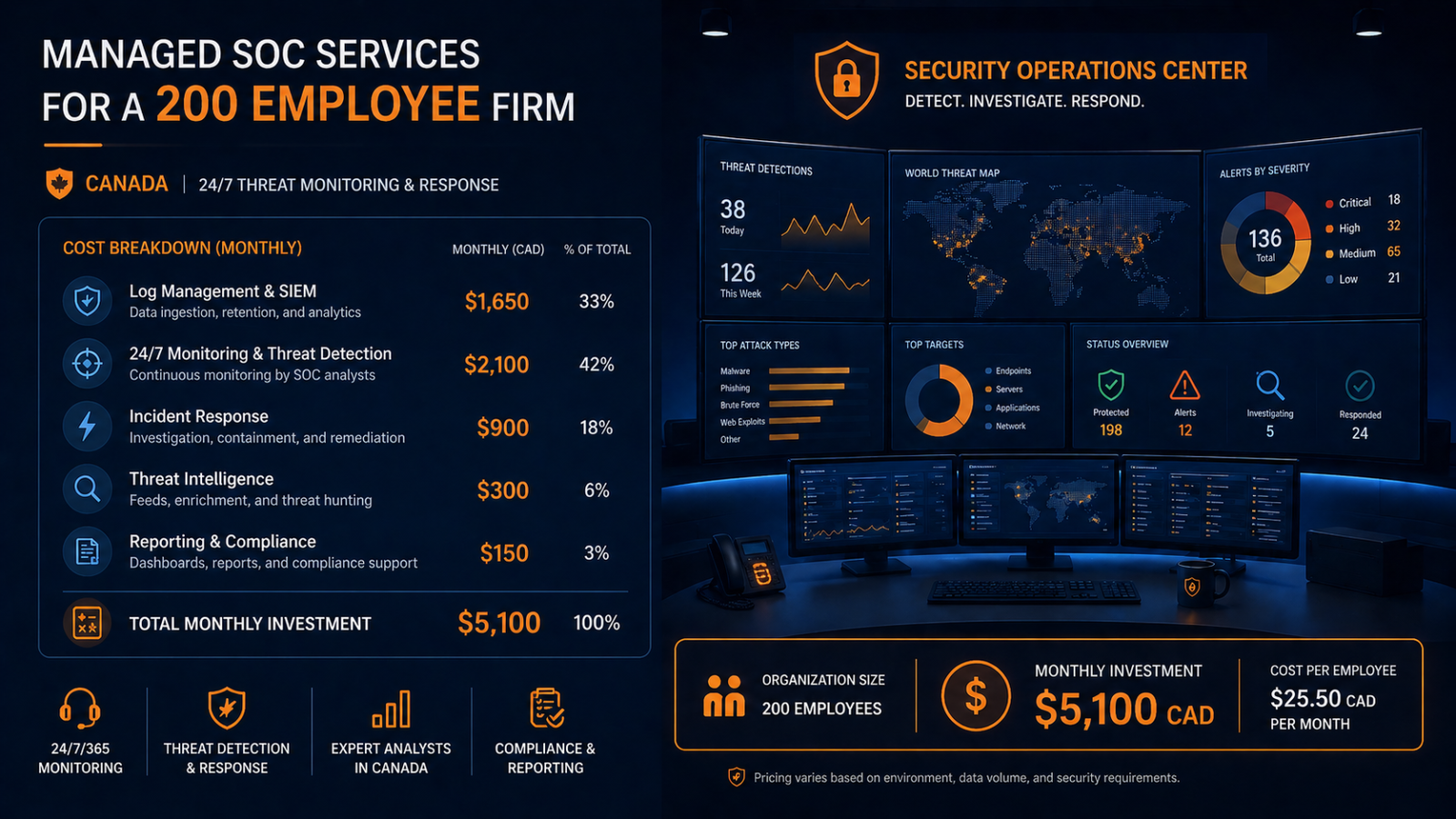
The short version. Managed SOC services for a 200 employee firm in Canada in 2026 typically run between $4,500 and $14,000 CAD per month, depending on what is included. The wide range reflects real differences in scope. The low end is alert triage only, often called managed detection and response (MDR). The high end includes proactive threat hunting, incident response retainer, executive reporting, and integration with your existing tooling. The middle, around $7,000 to $9,000 CAD per month, is where most firms in your size range land for a comprehensive offering.
Building the equivalent in-house starts at roughly $700,000 CAD per year for the staffing alone (three SOC analysts plus a manager) and that does not include tooling, infrastructure, or 24/7 coverage. The math is rarely close.
What a managed SOC actually includes
Always included
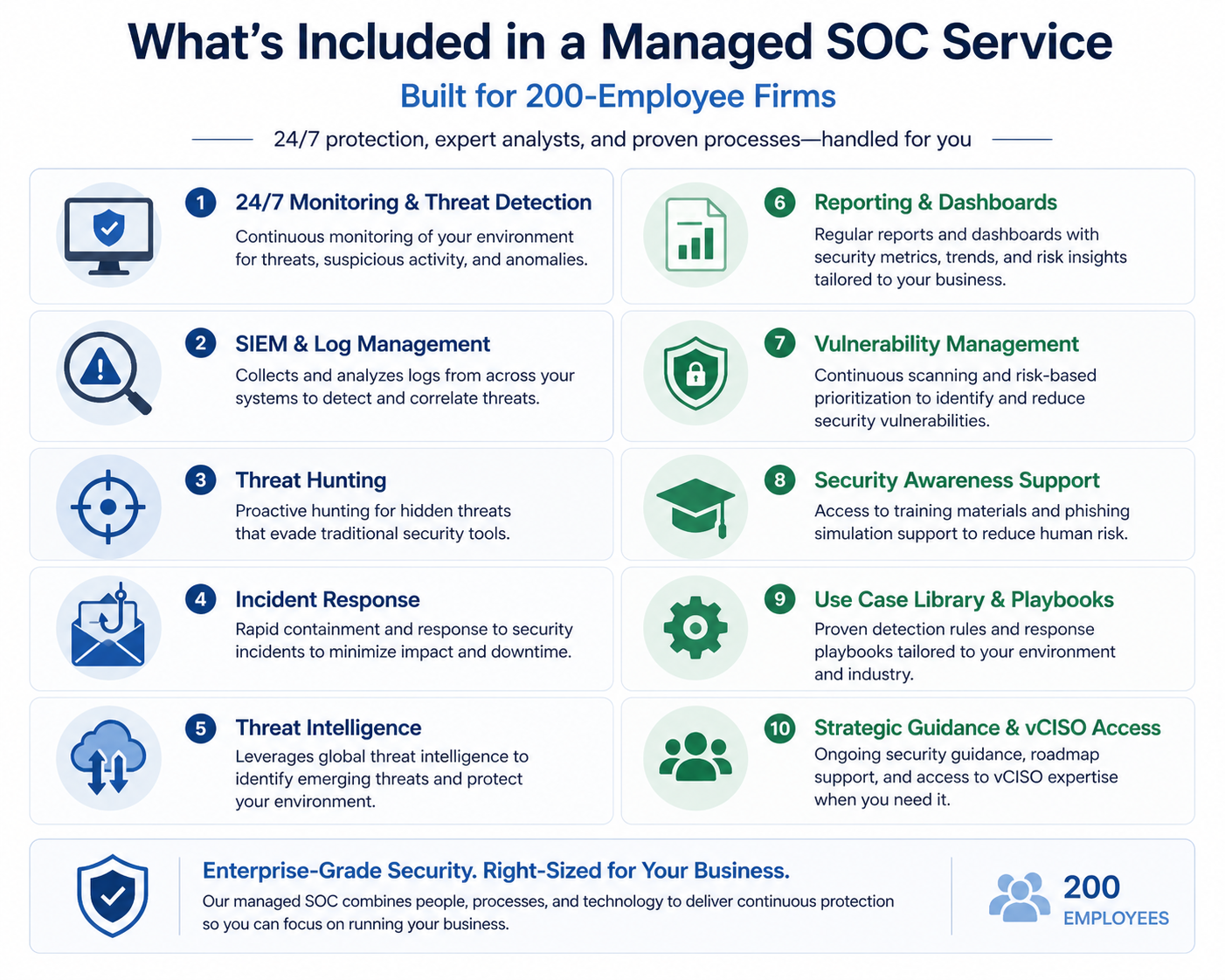
24/7 monitoring of telemetry from your endpoints (EDR), email security, identity (M365/Entra ID logs), and at least one network source (firewall logs or NDR). Alert triage by trained analysts. Incident notification within a defined SLA (typically 15 minutes for high severity). A monthly summary report.
Often included at mid range
Proactive threat hunting based on threat intelligence feeds. Quarterly tuning of detection rules to your environment. Integration with your SIEM if you have one, or a managed SIEM if you do not. Vulnerability scanning. Phishing simulation. A named SOC manager who knows your environment.
Premium add-ons
Incident response retainer with on-site or remote IR team available within hours, not days. Tabletop exercise facilitation. Compliance evidence packaging for SOC 2, ISO 27001, or sector-specific frameworks. Custom dashboards for executive reporting. Threat actor attribution. Most premium services add $2,000 to $5,000 CAD per month on top of the core.
The cost breakdown
For a 200 employee firm in Canada with reasonably standard infrastructure (Microsoft 365, hybrid AD, on-prem servers, cloud workloads on Azure or AWS, a few thousand endpoints across staff and contractors), the cost breaks down approximately as follows.
Tier 1, alert triage only (MDR), $4,500 to $6,500 CAD/month. EDR-focused monitoring, email security alerts, basic identity events. Notifications when something serious happens. No threat hunting, no tuning, no IR retainer. Suitable for firms that already have an internal incident handler and just need eyes on alerts overnight.
Tier 2, comprehensive managed SOC, $7,000 to $9,500 CAD/month. Everything in Tier 1 plus threat hunting, network telemetry monitoring, tuning, monthly executive reporting, and a 60 minute monthly review with the SOC team. Suitable for most firms in the 200 employee range without a dedicated security team.
Tier 3, comprehensive plus IR and compliance, $11,000 to $14,000 CAD/month. Everything in Tier 2 plus IR retainer, tabletop exercises, compliance evidence support, and quarterly tuning. Suitable for firms in regulated industries or those targeting SOC 2 / ISO certification.
In-house comparison
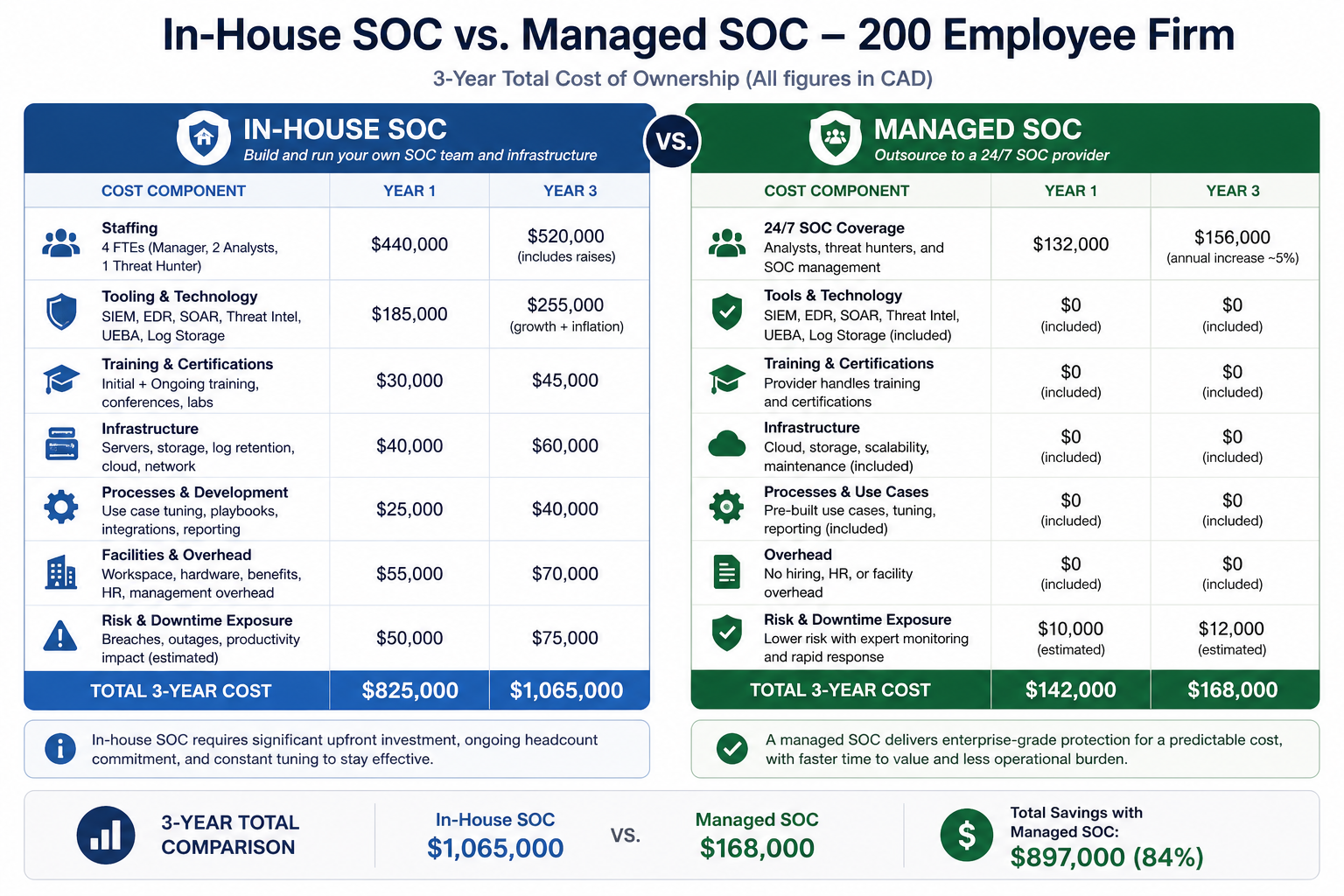
Building an in-house SOC for 24/7 coverage at a 200 employee firm requires a minimum of three security analysts (to cover three shifts) plus a SOC manager. In Canada, fully loaded compensation for SOC analysts in 2026 is roughly $90,000 to $130,000 CAD each, and a SOC manager is $140,000 to $180,000 CAD. That is roughly $440,000 to $570,000 CAD in salaries alone, before tooling.
Add SIEM licensing ($60,000 to $120,000 per year for a firm of this size), threat intelligence feeds ($30,000 to $60,000), training and certifications ($15,000 per analyst per year), and you are at roughly $700,000 to $900,000 CAD per year, plus turnover costs because SOC analysts are hard to retain.
Tier 2 managed SOC at $7,000 to $9,500 per month is $84,000 to $114,000 per year. The in-house option is 7 to 10 times more expensive at this size, and the managed option typically delivers more analyst experience because providers see threats across hundreds of clients.
What to evaluate when comparing quotes
Quotes from MSSPs vary because they are pricing different things. Three questions get to the actual scope.
What telemetry sources are included? EDR only, or EDR plus email plus identity plus network? More sources mean better detection but cost more.
What is the response on a high severity incident? Phone call within 15 minutes? Email within an hour? Hands-on remote remediation? Each is different.
Who tunes the detection rules? The provider, customized to your environment? Or off-the-shelf rules with no customization? The latter generates floods of false positives that erode trust within months.
What we see firms get wrong
Three patterns. First, hiring a low-end MDR thinking it is a full SOC, then being surprised when nobody is hunting threats or tuning. Second, paying for premium services they do not use, such as quarterly tabletops at firms that never actually run them. Third, picking the lowest quote without evaluating the analyst tier behind it. SOC providers vary enormously in analyst experience, and the cheap providers often run with junior staff who escalate everything to the customer rather than investigating.
FAQ
Can a smaller firm benefit from a managed SOC?
Yes. The math gets even more favorable below 200 employees, because in-house becomes essentially impossible. Pricing for a 50 employee firm is typically $2,500 to $4,500 CAD per month for Tier 2 equivalent.
Should I expect a contract commitment?
Most managed SOC contracts are 12 to 36 months. Shorter terms cost more per month. Negotiate annual price reviews if signing 3-year contracts.
Will my cyber insurance recognize a managed SOC?
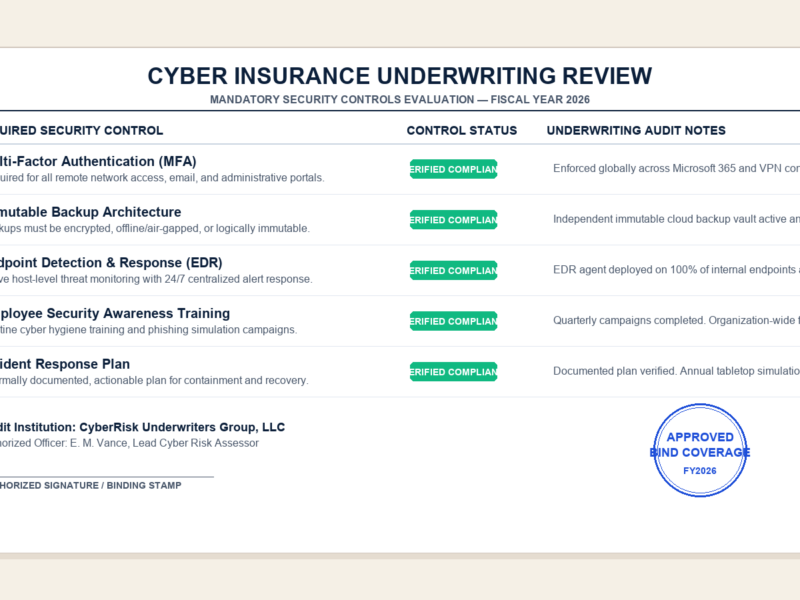
Yes, and it often lowers premium. Most insurers now ask whether you have 24/7 monitoring as part of underwriting.
Related posts
- HIPAA Network Segmentation Requirements
- PCI-DSS for Edmonton Retail WiFi
- Hidden Risks of Co-Managed Microsoft 365
If you are evaluating SOC options
If you are building a budget request or comparing MSSP quotes, our team can walk through your environment and give you an honest read on what you actually need versus what providers will try to sell you. Book a 60 minute scoping call and we will help you build the right ask.
Last verified April 2026 by the aaanetworkx security practice.