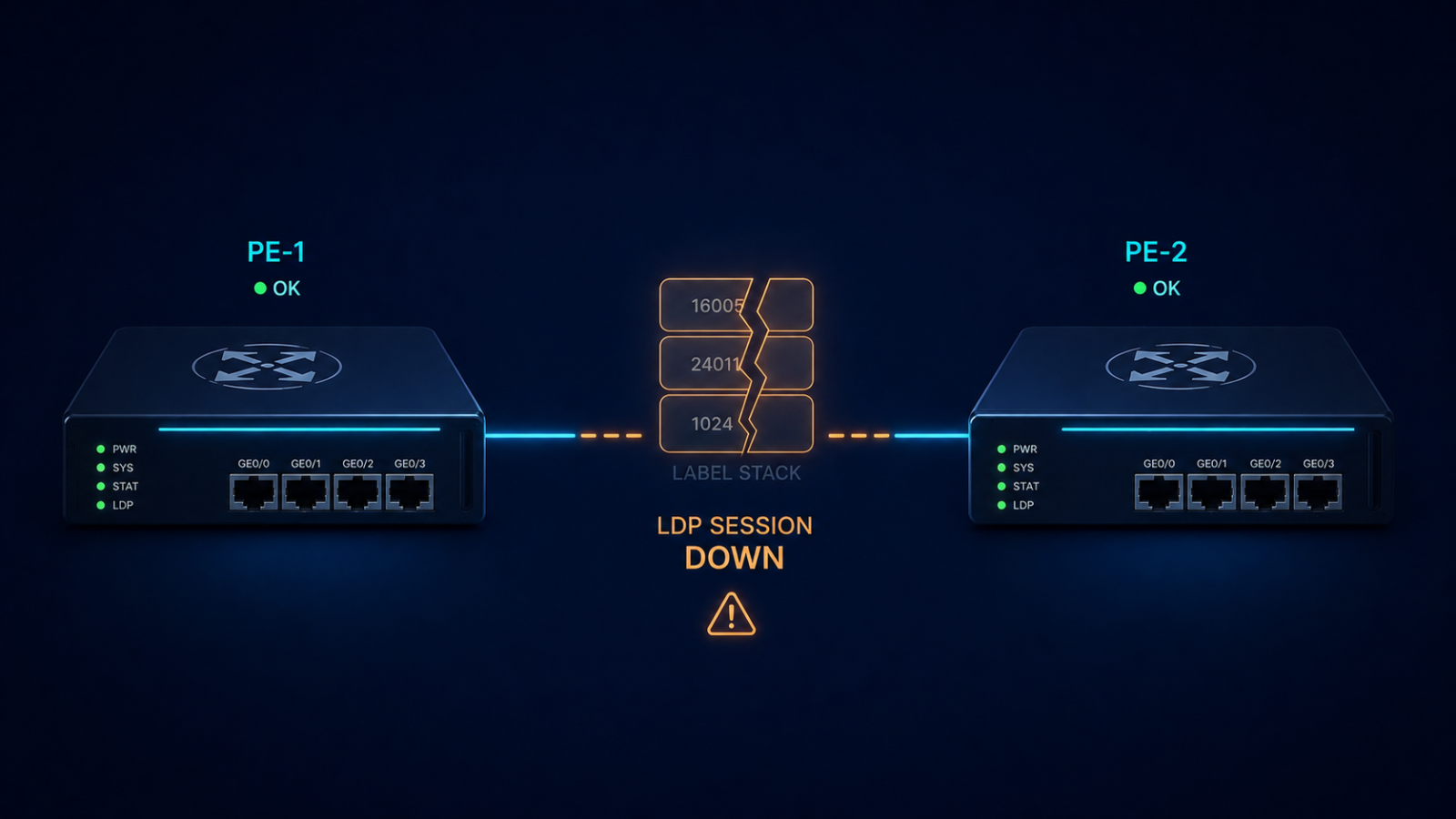
MPLS LDP neighbor down means the label distribution session between two routers has failed and forwarding is broken between them.
MPLS LDP is the protocol that distributes labels between routers in your MPLS network. When the session goes down, MPLS forwarding stops working between those two routers, and any service that depends on that path (L3VPN, L2VPN, traffic engineering) goes with it. This post walks through the five real causes of LDP neighbor down ranked by frequency, the diagnostic order, and the architectural fix that stops it from recurring.
The short version. About 30 percent of LDP down incidents are TCP transport address misconfiguration, where the LDP session cannot establish even though the hello adjacency works. Another 25 percent are IGP convergence issues that interrupt the route to the LDP transport address. The rest split across ACL/firewall blocking TCP 646, MTU mismatch on the link, and authentication drift. Diagnostic order matters. Check IGP first, transport address second, TCP reachability third, before any labels are exchanged.
What LDP down actually means
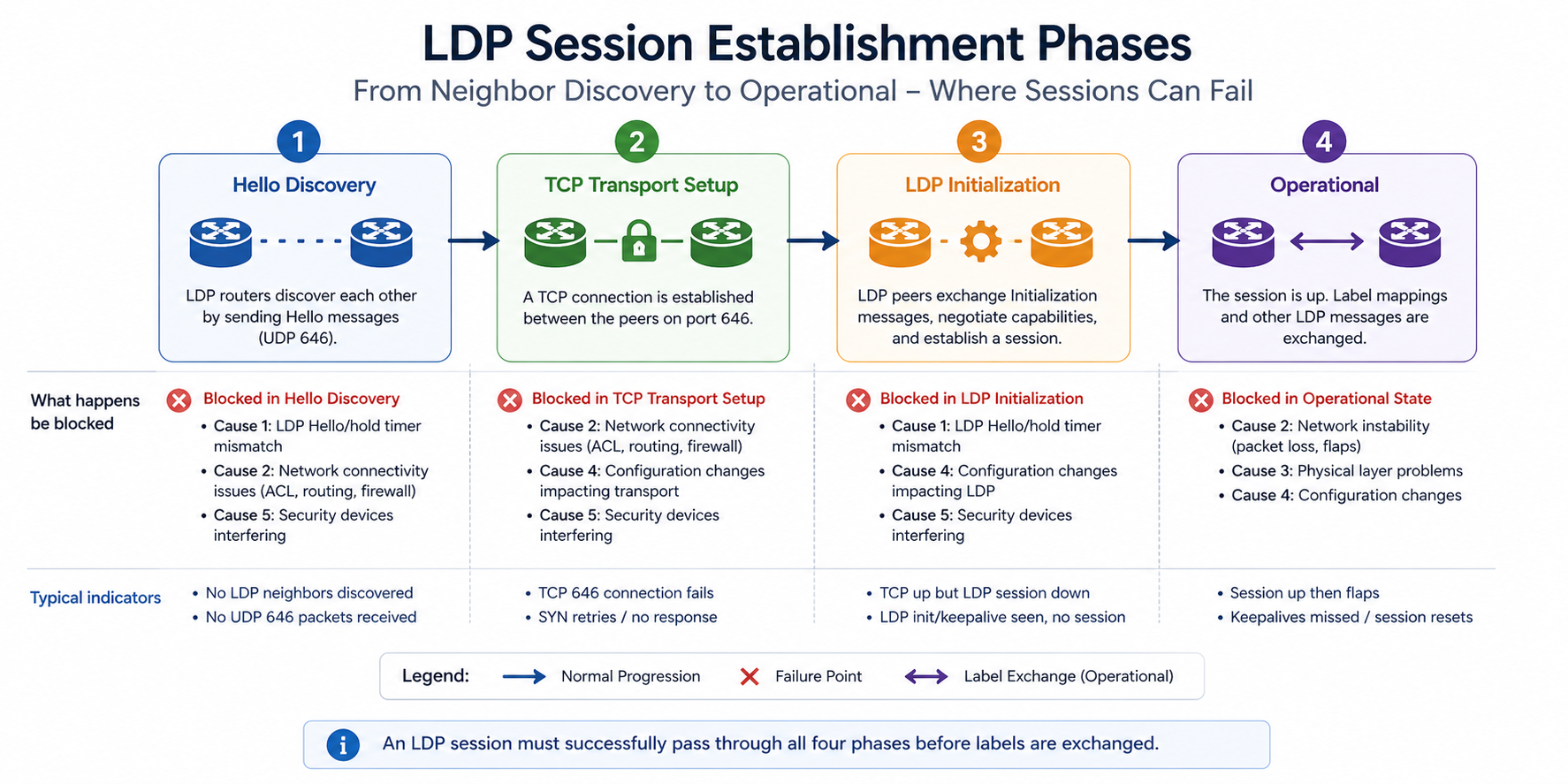
LDP runs in two phases. The hello phase uses UDP 646 between directly connected interfaces to discover potential LDP peers. The session phase uses TCP 646 between the two routers’ transport addresses (typically loopback addresses) to establish the actual LDP session that exchanges labels. If hello succeeds but TCP session fails, the neighbor shows in the hello adjacency table but not in the operational session table.
You will see this in three places. show mpls ldp neighbor shows no operational neighbor or shows it in a transient state. show mpls ldp discovery shows the hello adjacency. debug mpls ldp transport shows TCP connection failures. Your monitoring system flags affected MPLS services as down.
Verified against current Cisco IOS-XR and Juniper Junos LDP documentation, accessed April 2026.
The five causes, ranked
Cause one, transport address misconfiguration, around 30 percent
The LDP transport address (the address LDP uses to establish the TCP session) is configured to a loopback that does not exist, is shut down, or is not advertised by the IGP. Hello adjacency works because it uses interface addresses, but TCP session fails because the transport address is unreachable.
Verify with show mpls ldp parameters on both sides. The router-id and transport-address should be loopback addresses that are up, configured, and reachable across the IGP. Fix any mismatch.
Cause two, IGP route to transport address missing, around 25 percent
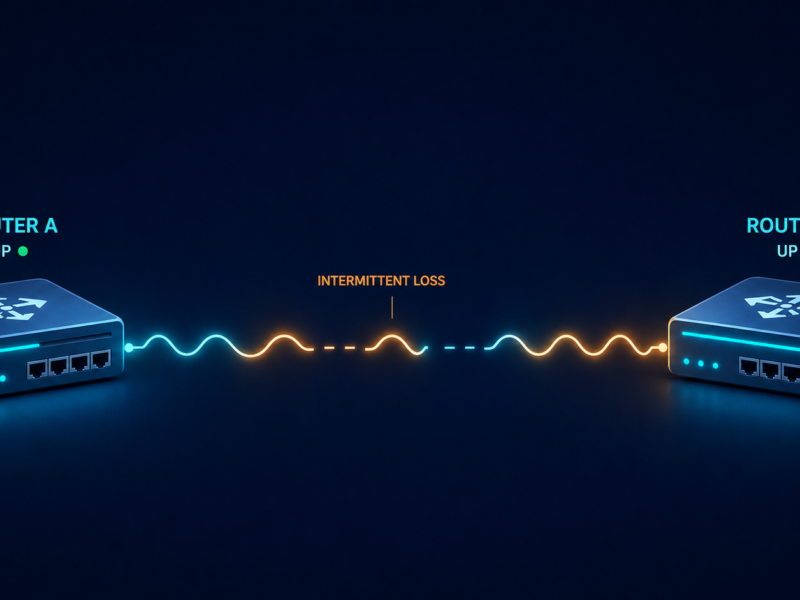
The transport address is correctly configured but the IGP is not advertising it, or convergence has temporarily removed the route. LDP cannot bring up the session because TCP cannot reach the destination.
Verify with show ip route x.x.x.x for the neighbor’s transport address. If no route exists or the route flaps, fix the underlying IGP issue first. LDP will recover automatically once the route stabilizes.
Cause three, ACL or firewall blocking TCP 646, around 20 percent
An ACL on a transit router or a security policy on a firewall is blocking TCP 646 between the two transport addresses. Often happens after a security audit tightens default rules.
Verify with telnet x.x.x.x 646 from one router to the other. If TCP connection fails, trace the path and find the offending filter.
Cause four, MTU mismatch on the link, around 15 percent
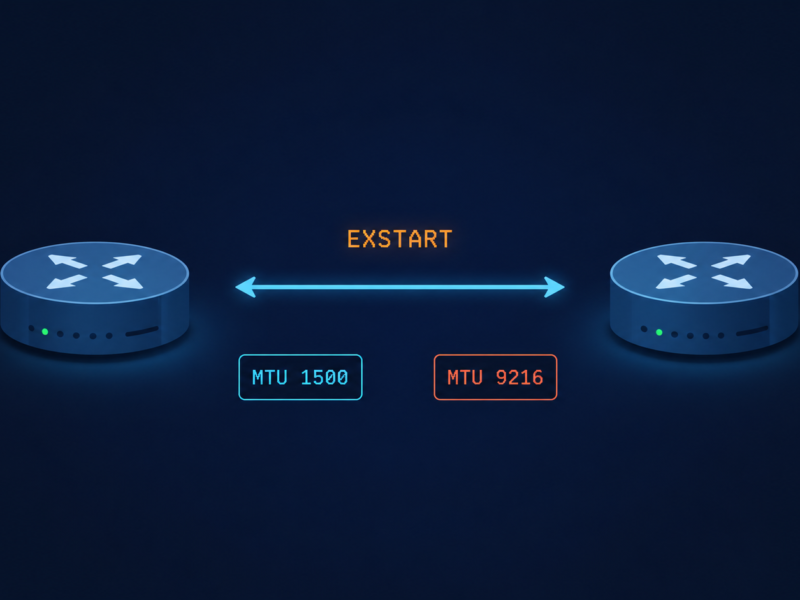
MPLS adds 4 bytes per label. If the underlying interface MTU is not big enough to carry IP plus the maximum label stack, large LDP messages or labeled traffic gets dropped. LDP session can establish then drop after initialization.
Verify with interface MTU on both sides and confirm it accommodates the full label stack you expect to push (4 bytes per label, plus IP plus L2 framing).
Cause five, authentication drift, around 10 percent
If LDP TCP authentication is configured (MD5 or TCP-AO), a key mismatch on one side causes the TCP session to never establish. Hello succeeds, TCP handshake fails.
Verify with show mpls ldp neighbor detail and check authentication settings on both sides. Fix the mismatch.
What the official documentation does not mention
Vendor docs walk through the LDP states but rarely explain that LDP session establishment depends on TCP, which depends on IGP, which depends on the underlying interface. So when LDP fails, the cause is often two or three layers below LDP itself. Always start at the bottom of the stack and work up. A flapping interface produces an LDP error message that looks like an LDP problem but is actually a physical layer issue.
Also, when migrating from LDP to Segment Routing, both can run simultaneously and produce confusing log messages as labels overlap during transition. Plan migrations with explicit LDP/SR coexistence in mind.
The architectural fix
Networks that rarely see LDP issues do four things. First, every router uses its loopback as the LDP transport address consistently, with the loopback advertised by the IGP. Second, ACLs at internal boundaries explicitly permit TCP 646 with documented justification. Third, MTU is standardized network-wide with margin for the maximum label stack. Fourth, monitoring alerts on LDP neighbor state changes alongside IGP route changes so the correlation is obvious. Skip any of these and LDP becomes the symptom of an underlying issue rather than its own well-managed protocol.
FAQ
Will LDP session re-establish on its own?
Yes, once the underlying issue clears (route restored, ACL fixed, MTU aligned). LDP retries every 15 seconds by default.
Should I migrate to Segment Routing?
That is a strategic decision, not an LDP fix. Segment Routing eliminates the need for LDP but requires platform support and operational change.
Does LDP graceful restart help?
Yes for planned events like software upgrades, no for actual link or configuration issues.
Related posts
Need a second opinion on an MPLS issue
MPLS issues touch IGP, LDP, BGP, and the underlying physical layer all at once. Our routing practice has helped service providers across Western Canada untangle LDP issues that turned out to be IGP or transport problems. Send us the topology and the symptom and we will help you isolate it.
Last verified April 2026 by the aaanetworkx routing practice.