EVPN VXLAN vs traditional L2 is the most common data center architecture decision in 2026, and the answer is not always EVPN.
Every data center network refresh in the last five years has come with the same conversation. Should we go to EVPN-VXLAN or stay with traditional Layer 2? Vendor marketing says EVPN. Conservative ops teams say “if it ain’t broke, don’t fix it.” Both are partially right. This post compares the two honestly, based on what we have seen work and not work for real environments, and gives you a decision framework that fits your situation, not which one is best universally.
The short version. EVPN-VXLAN wins decisively in environments with multi-tenant requirements, large scale (hundreds of VLANs or VRFs), heavy east-west traffic, or geographic distribution. Traditional Layer 2 wins in smaller environments where simplicity and team familiarity outweigh future flexibility, especially with under 50 VLANs and a single physical site. The middle is the hard part, and that is where most of these decisions actually live.
Quick definitions, just in case
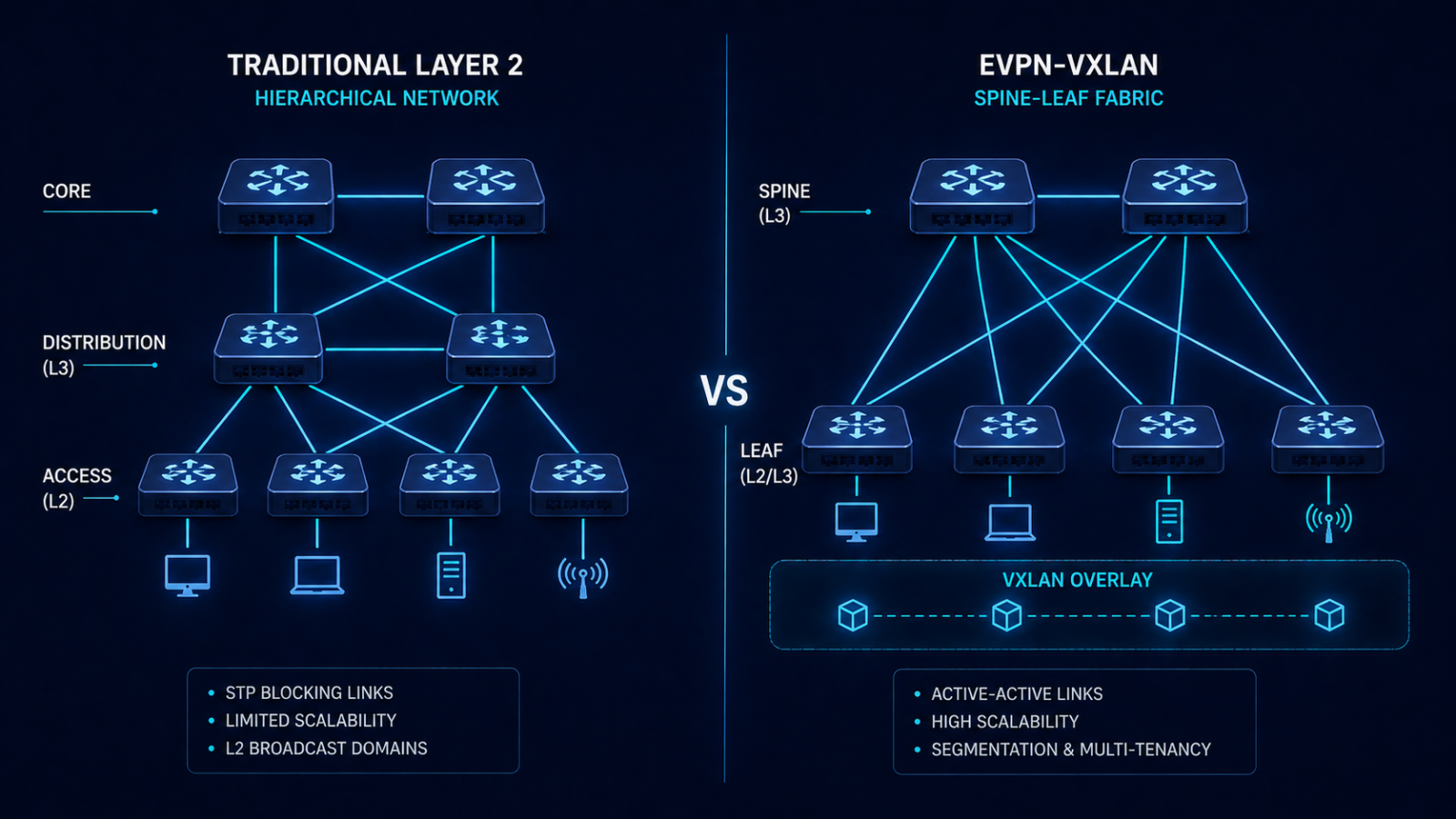
Traditional Layer 2 means hierarchical Ethernet, with VLANs spanning a core, distribution, and access layer. STP or MLAG handles loop prevention. VLAN extension between sites uses some form of L2VPN or DCI tunnel.
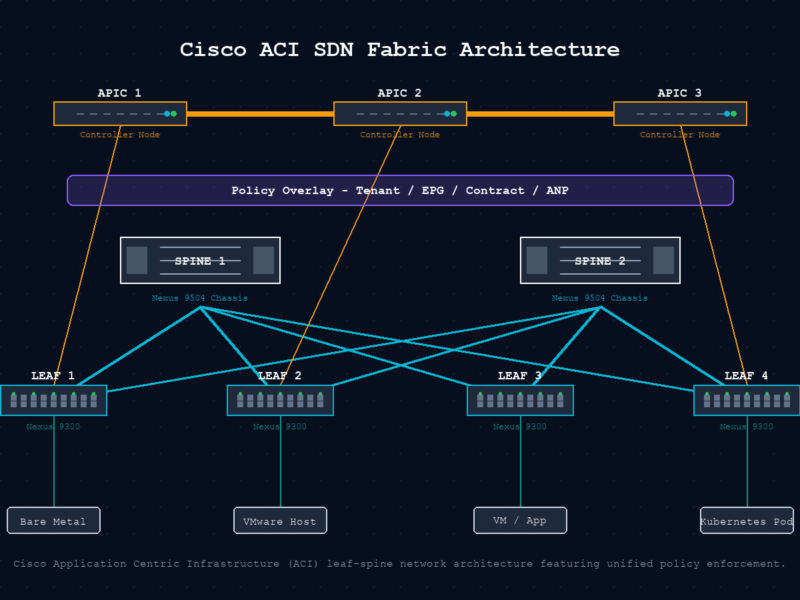
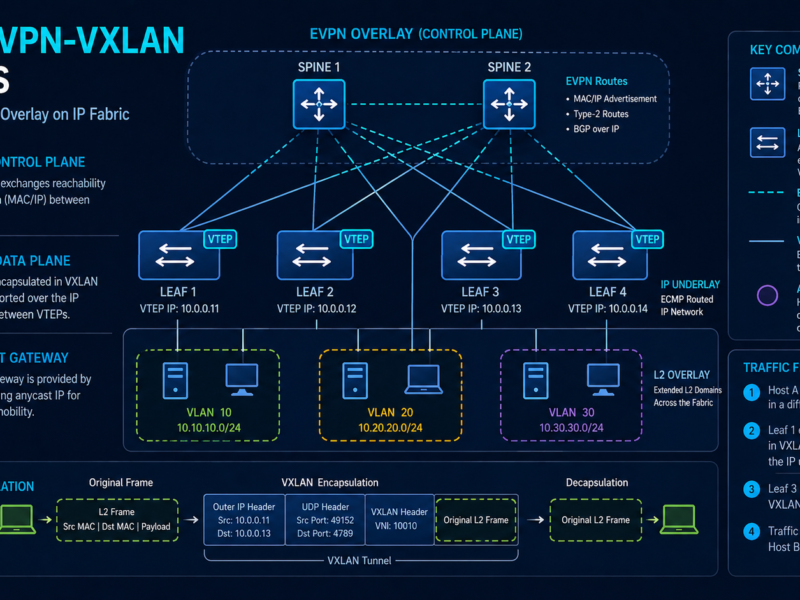
EVPN-VXLAN is a fabric design where a routed underlay (typically eBGP per leaf-spine session) carries IP between every VTEP, and an EVPN overlay carries MAC-IP and IP prefix information that builds virtual networks on top. VXLAN encapsulation tunnels Layer 2 over Layer 3, so any leaf can reach any other leaf for any tenant without spanning tree.
Where EVPN-VXLAN wins
Multi-tenancy at scale. EVPN handles thousands of L2 and L3 virtual networks with route distinguisher and route target controls. Traditional Layer 2 with VLANs caps at 4094, and managing more than a few hundred VLANs cleanly is operationally painful.
Stretched data centers. EVPN gives you Layer 2 mobility across sites without requiring traditional DCI gymnastics. Move a workload between sites and the MAC follows.
Scale-out east-west traffic. Spine-leaf with ECMP routing eliminates the bottleneck of traditional 3-tier where most traffic has to traverse core links. Modern application architectures (microservices, large analytics) thrive on this.
Predictable convergence. With routed underlay and BGP, failures converge in seconds without spanning tree drama.
Operational consistency at scale. Once you understand the fabric, every leaf is identical. New leaves are added with a few lines of configuration and EVPN auto-discovers them.
Where traditional Layer 2 still wins
Small environments. A 50-host data center with 20 VLANs and a single site does not benefit from EVPN. The complexity overhead exceeds the operational gain. Two well-configured stacked switches with MLAG is simpler, cheaper, and reliable.
Team familiarity. EVPN requires comfort with BGP, route targets, MAC mobility, and overlay troubleshooting. Teams that operate confidently with VLANs and STP can stumble badly during the EVPN learning curve. The wrong technology run by the wrong team is worse than the right technology run by the wrong team.
Legacy application requirements. Some legacy applications expect specific multicast or broadcast behaviors that work flawlessly on classic L2 and require careful EVPN configuration to support. The application team is rarely happy to update for an infrastructure refresh.
Budget constraints. Spine-leaf with 100G or 400G uplinks is more capital intensive upfront than refreshing a 3-tier network with current generation switches. The TCO often favors EVPN over five years, but year one cost can exceed a traditional refresh.
The honest tradeoff matrix
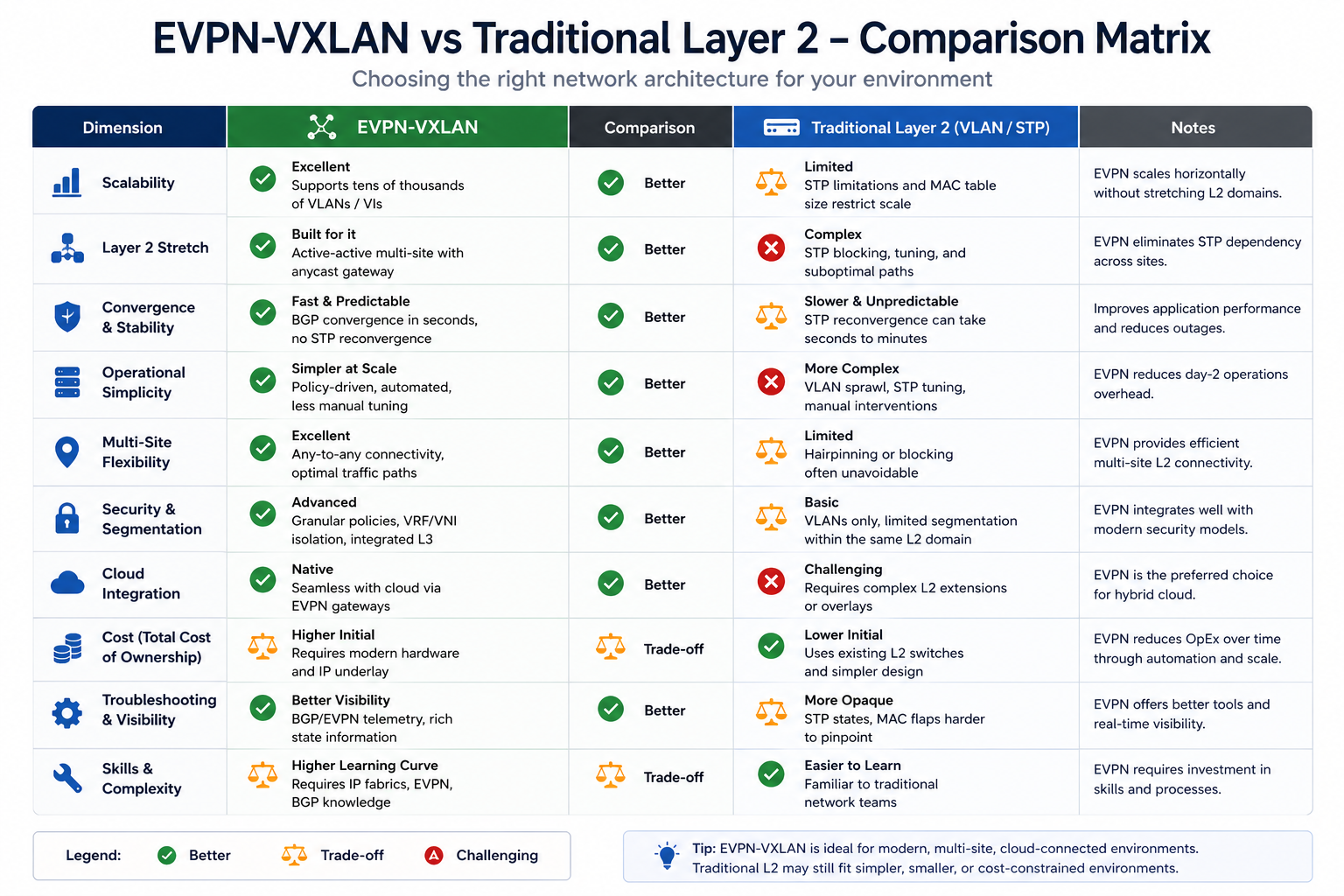
Some things EVPN-VXLAN does better, some things traditional L2 still does better, and some things are about even depending on configuration. Here is the honest take based on production experience.
Scale: EVPN wins decisively above ~100 VLANs or multi-site requirements.
Operational complexity: Traditional L2 wins for small networks, EVPN wins for large.
Convergence time: EVPN wins, sub-second failover with proper BFD tuning.
Vendor lock-in: EVPN is more standardized, but multi-vendor still has interop quirks.
Day-2 troubleshooting: EVPN is harder for engineers new to it. Plan for training.
Cost (CapEx): Traditional L2 wins for small environments. EVPN wins TCO above ~100 hosts.
Future flexibility: EVPN wins by a wide margin.
Maturity: Both are mature in 2026. EVPN is no longer bleeding edge.
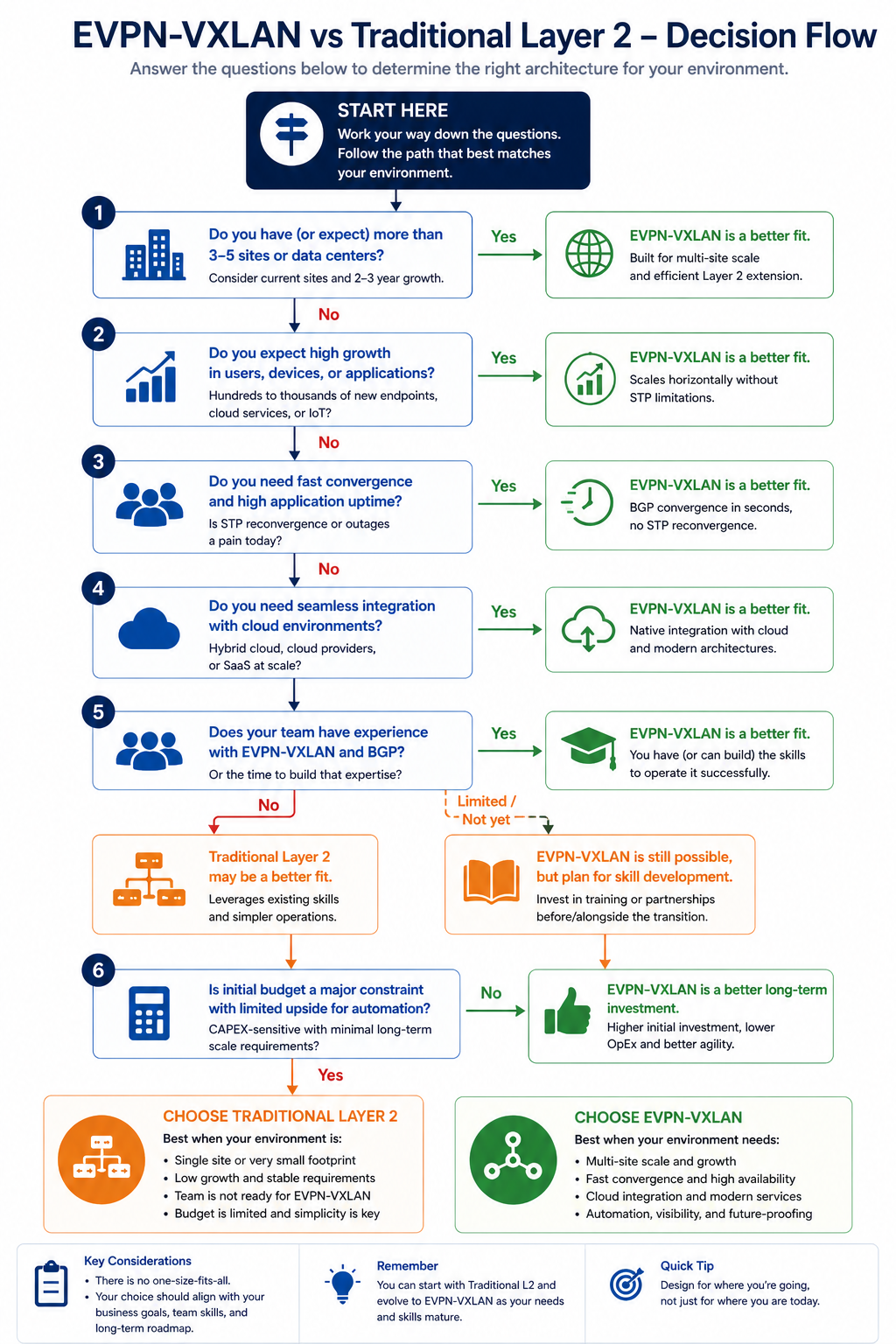
How to actually choose
Three questions narrow most decisions to one option.
Question one: how many tenants or VLANs do you need to support in five years? If under 50 and not growing, traditional Layer 2 is fine. If above 100 or growing fast, lean EVPN.
Question two: are you single-site or multi-site? Single-site under 100 hosts, traditional is reasonable. Multi-site with workload mobility, EVPN is the right answer.
Question three: does your team have BGP comfort? No, and no plan to gain it, traditional L2. Yes, or willing to invest in training, EVPN. Do not deploy EVPN with a team that will not be comfortable operating it. The first incident at 3am will be brutal.
What we see go wrong in EVPN deployments
Three patterns repeat. First, teams adopt EVPN because vendors recommended it but never invest in BGP and overlay training. Operations becomes painful, the team blames EVPN, and the network ends up worse than the L2 design they replaced. Second, teams over-engineer with multi-vendor fabrics on day one to avoid lock-in, then discover that interop quirks consume their first six months. Third, teams adopt EVPN at scale where traditional L2 would have been sufficient, paying for complexity they do not need.
FAQ
Can I run both in parallel during transition?
Yes. Most large transitions run both for 12 to 24 months while migrating workloads. Plan the integration carefully and isolate failure domains.
Is EVPN-VXLAN good for small businesses?
Almost never. The complexity is not justified. Use traditional Layer 2 with stacked switches.
Will my application teams notice?
If done right, no. EVPN should be transparent to applications. If applications notice, something was deployed incorrectly.
Related posts
Need a design opinion
Picking between EVPN-VXLAN and traditional Layer 2 is a five to ten year decision. Our data center practice has designed both, and we are comfortable telling you the boring answer when boring is right. Tell us about your environment and we will give you an honest recommendation.
Last verified April 2026 by the aaanetworkx data center practice.