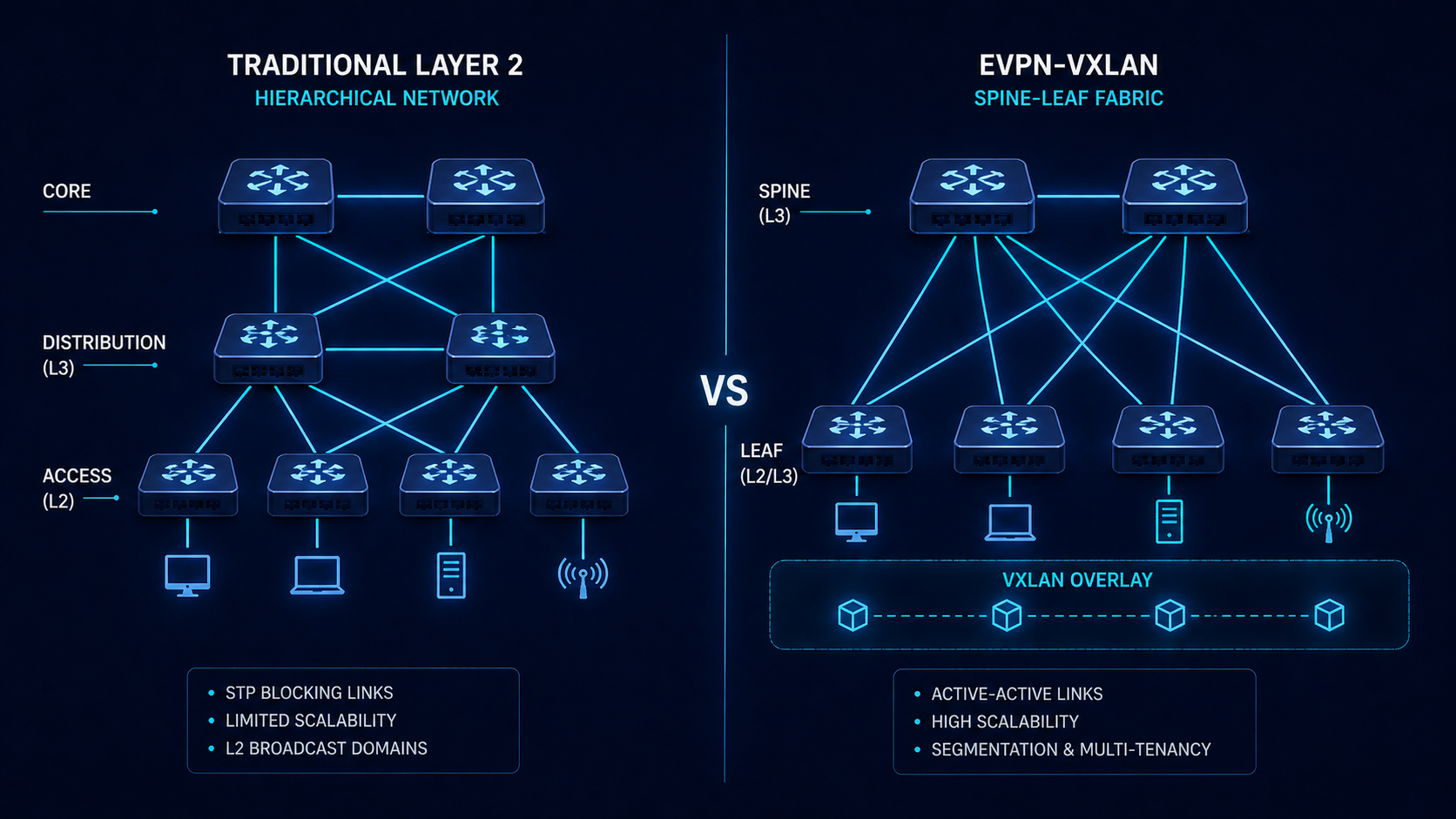
EVPN VXLAN vs traditional L2 is the most common data center architecture decision in 2026, and the answer is not always EVPN.
Every data center network refresh in the last five years has come with the same conversation. Should we go to EVPN-VXLAN or stay with traditional Layer 2? Vendor marketing says EVPN. Conservative ops teams say “if it ain’t broke, don’t fix it.” Both are partially right. This post compares the two honestly, based on what we have seen work and not work for real environments, and gives you a decision framework that fits your situation, not which one is best universally.
The short version. EVPN-VXLAN wins decisively in environments with multi-tenant requirements, large scale (hundreds of VLANs or VRFs), heavy east-west traffic, or geographic distribution. Traditional Layer 2 wins in smaller environments where simplicity and team familiarity outweigh future flexibility, especially with under 50 VLANs and a single physical site. The middle is the hard part, and that is where most of these decisions actually live.
Quick definitions, just in case
Traditional Layer 2 means hierarchical Ethernet, with VLANs spanning a core, distribution, and access layer. STP or MLAG handles loop prevention. VLAN extension between sites uses some form of L2VPN or DCI tunnel.
EVPN-VXLAN is a fabric design where a routed underlay (typically eBGP per leaf-spine session) carries IP between every VTEP, and an EVPN overlay carries MAC-IP and IP prefix information that builds virtual networks on top. VXLAN encapsulation tunnels Layer 2 over Layer 3, so any leaf can reach any other leaf for any tenant without spanning tree.
Where EVPN-VXLAN wins
Multi-tenancy at scale. EVPN handles thousands of L2 and L3 virtual networks with route distinguisher and route target controls. Traditional Layer 2 with VLANs caps at 4094, and managing more than a few hundred VLANs cleanly is operationally painful.
Stretched data centers. EVPN gives you Layer 2 mobility across sites without requiring traditional DCI gymnastics. Move a workload between sites and the MAC follows.
Scale-out east-west traffic. Spine-leaf with ECMP routing eliminates the bottleneck of traditional 3-tier where most traffic has to traverse core links. Modern application architectures (microservices, large analytics) thrive on this.
Predictable convergence. With routed underlay and BGP, failures converge in seconds without spanning tree drama.
Operational consistency at scale. Once you understand the fabric, every leaf is identical. New leaves are added with a few lines of configuration and EVPN auto-discovers them.
Where traditional Layer 2 still wins
Small environments. A 50-host data center with 20 VLANs and a single site does not benefit from EVPN. The complexity overhead exceeds the operational gain. Two well-configured stacked switches with MLAG is simpler, cheaper, and reliable.
Team familiarity. EVPN requires comfort with BGP, route targets, MAC mobility, and overlay troubleshooting. Teams that operate confidently with VLANs and STP can stumble badly during the EVPN learning curve. The wrong technology run by the wrong team is worse than the right technology run by the wrong team.
Legacy application requirements. Some legacy applications expect specific multicast or broadcast behaviors that work flawlessly on classic L2 and require careful EVPN configuration to support. The application team is rarely happy to update for an infrastructure refresh.
Budget constraints. Spine-leaf with 100G or 400G uplinks is more capital intensive upfront than refreshing a 3-tier network with current generation switches. The TCO often favors EVPN over five years, but year one cost can exceed a traditional refresh.
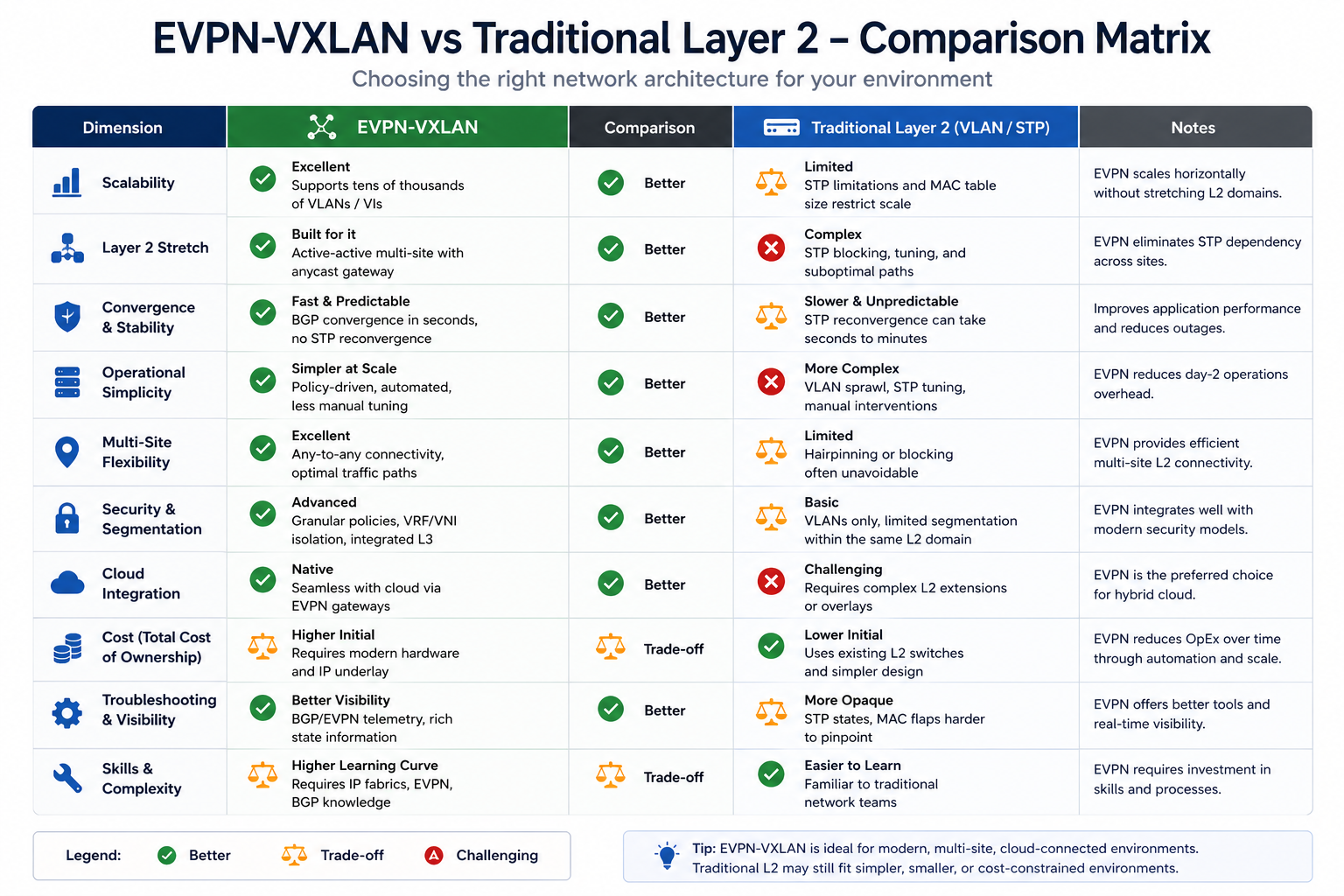
The honest tradeoff matrix
Some things EVPN-VXLAN does better, some things traditional L2 still does better, and some things are about even depending on configuration. Here is the honest take based on production experience.
Scale: EVPN wins decisively above ~100 VLANs or multi-site requirements.
Operational complexity: Traditional L2 wins for small networks, EVPN wins for large.
Convergence time: EVPN wins, sub-second failover with proper BFD tuning.
Vendor lock-in: EVPN is more standardized, but multi-vendor still has interop quirks.
Day-2 troubleshooting: EVPN is harder for engineers new to it. Plan for training.
Cost (CapEx): Traditional L2 wins for small environments. EVPN wins TCO above ~100 hosts.
Future flexibility: EVPN wins by a wide margin.
Maturity: Both are mature in 2026. EVPN is no longer bleeding edge.
How to actually choose
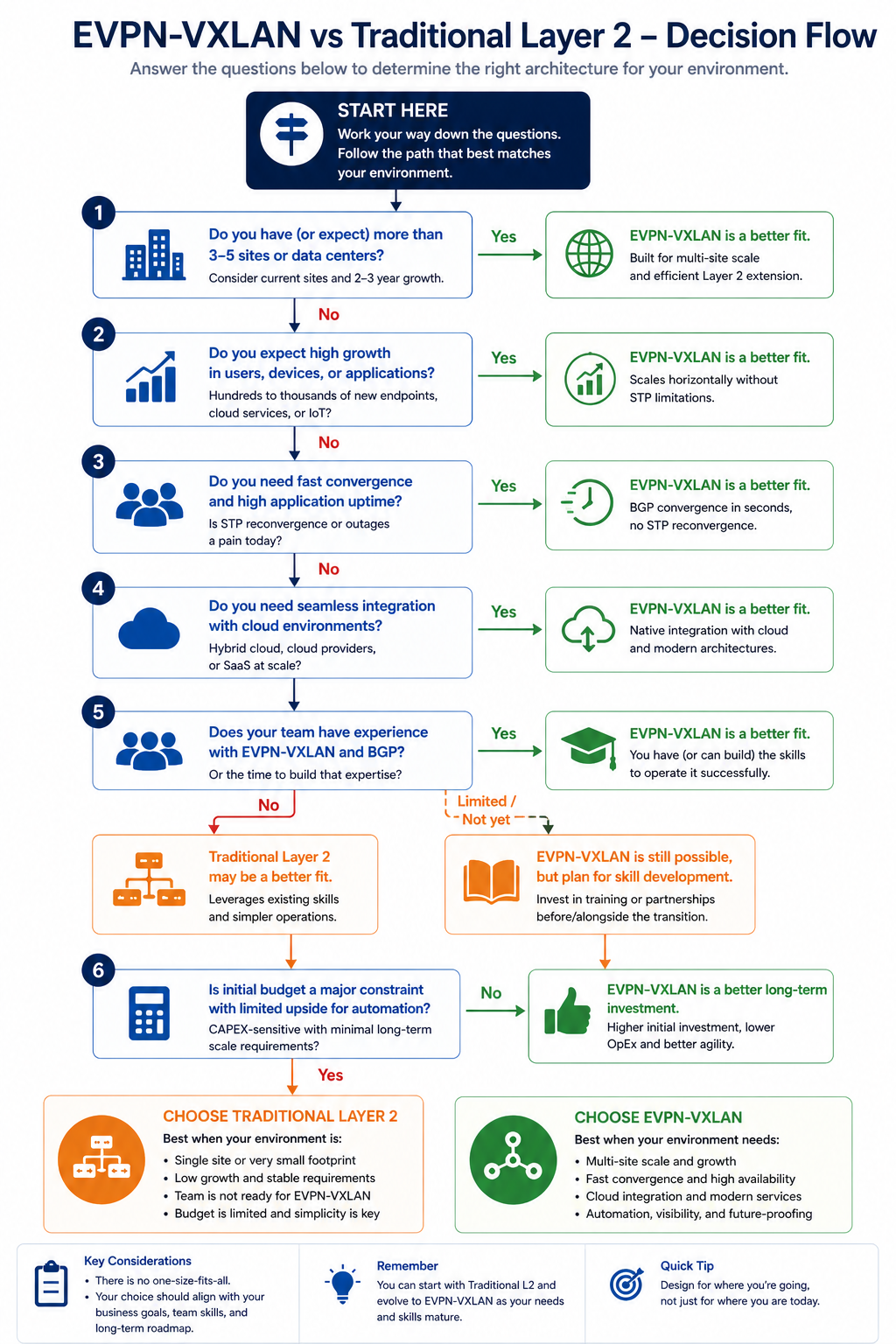
Three questions narrow most decisions to one option.
Question one: how many tenants or VLANs do you need to support in five years? If under 50 and not growing, traditional Layer 2 is fine. If above 100 or growing fast, lean EVPN.
Question two: are you single-site or multi-site? Single-site under 100 hosts, traditional is reasonable. Multi-site with workload mobility, EVPN is the right answer.
Question three: does your team have BGP comfort? No, and no plan to gain it, traditional L2. Yes, or willing to invest in training, EVPN. Do not deploy EVPN with a team that will not be comfortable operating it. The first incident at 3am will be brutal.
What we see go wrong in EVPN deployments
Three patterns repeat. First, teams adopt EVPN because vendors recommended it but never invest in BGP and overlay training. Operations becomes painful, the team blames EVPN, and the network ends up worse than the L2 design they replaced. Second, teams over-engineer with multi-vendor fabrics on day one to avoid lock-in, then discover that interop quirks consume their first six months. Third, teams adopt EVPN at scale where traditional L2 would have been sufficient, paying for complexity they do not need.
FAQ
Can I run both in parallel during transition?
Yes. Most large transitions run both for 12 to 24 months while migrating workloads. Plan the integration carefully and isolate failure domains.
Is EVPN-VXLAN good for small businesses?
Almost never. The complexity is not justified. Use traditional Layer 2 with stacked switches.
Will my application teams notice?
If done right, no. EVPN should be transparent to applications. If applications notice, something was deployed incorrectly.
Related posts
Need a design opinion
Picking between EVPN-VXLAN and traditional Layer 2 is a five to ten year decision. Our data center practice has designed both, and we are comfortable telling you the boring answer when boring is right. Tell us about your environment and we will give you an honest recommendation.
Last verified April 2026 by the aaanetworkx data center practice.
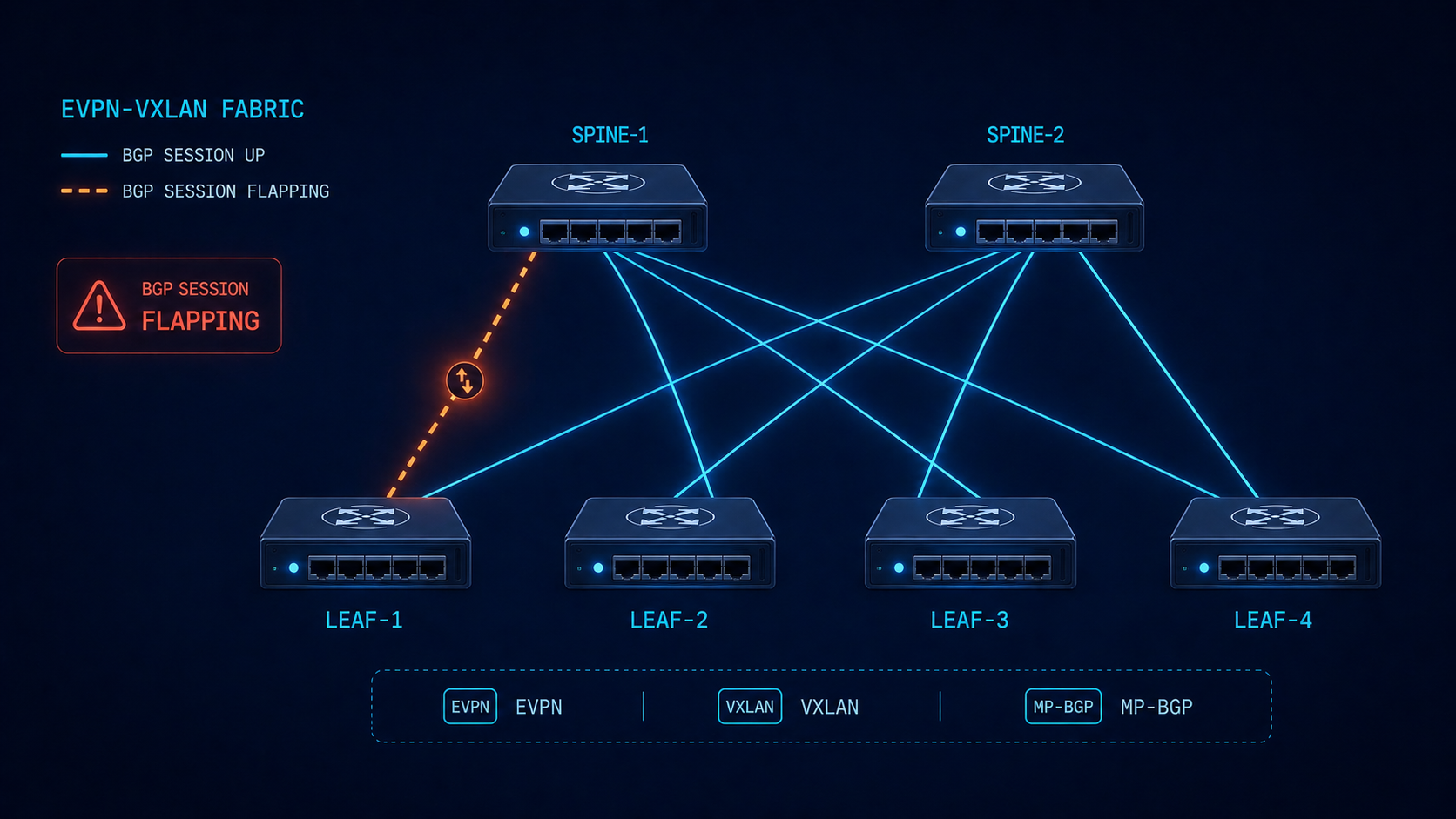
Troubleshoot BGP flapping EVPN fabrics by separating the underlay BGP from the overlay BGP first, because the symptoms look identical at the CLI.
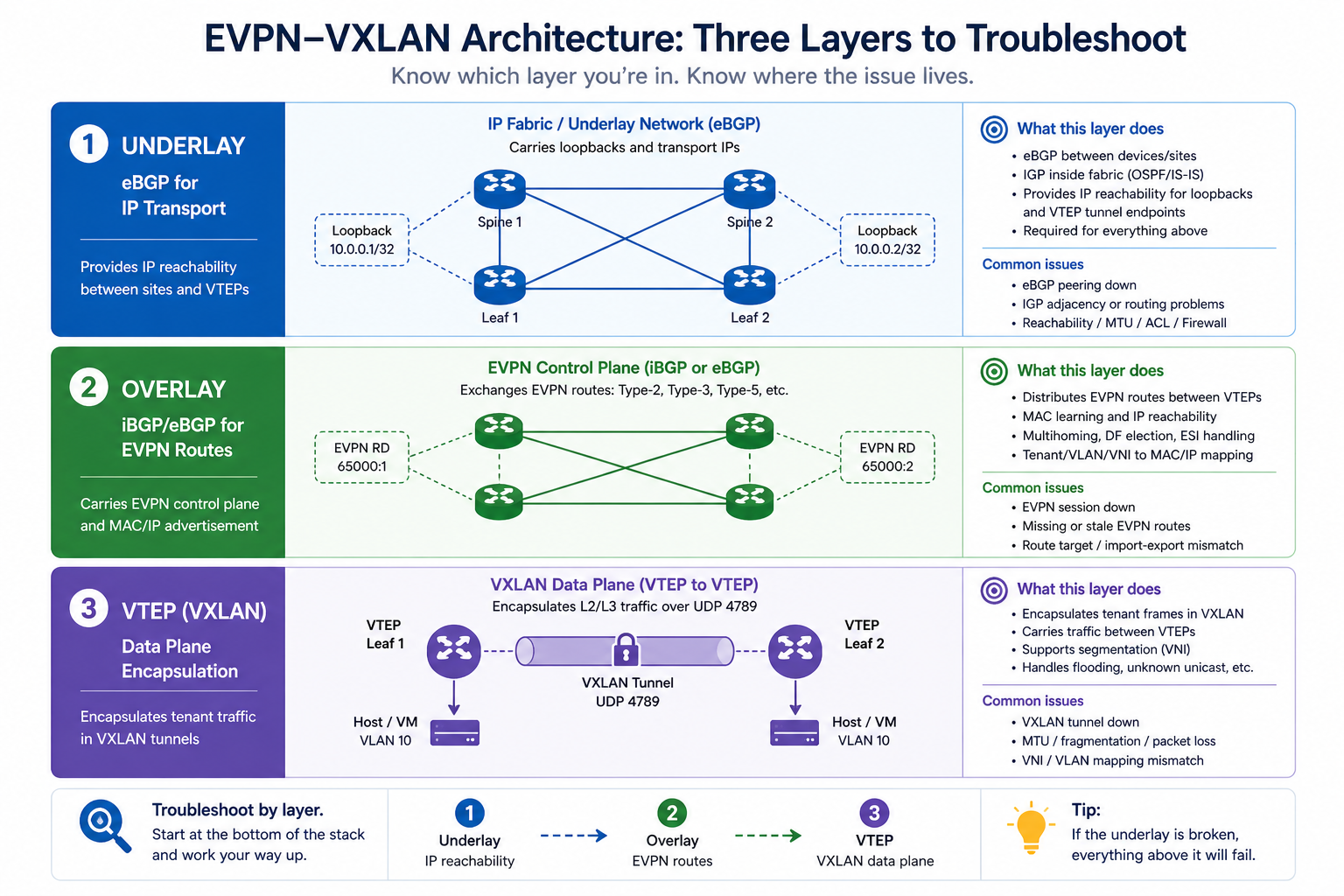
BGP in an EVPN-VXLAN fabric is doing two jobs at once. The underlay BGP carries IP reachability between VTEPs. The overlay BGP carries EVPN routes (MAC-IP, EAD, IMET, prefix routes) that build the actual virtual networks. When BGP flaps in this kind of environment, the cause might be in either layer, and the diagnostic approach is different from troubleshooting BGP on a single-layer network. This post walks through the diagnostic order we use in production fabrics to isolate the issue fast.
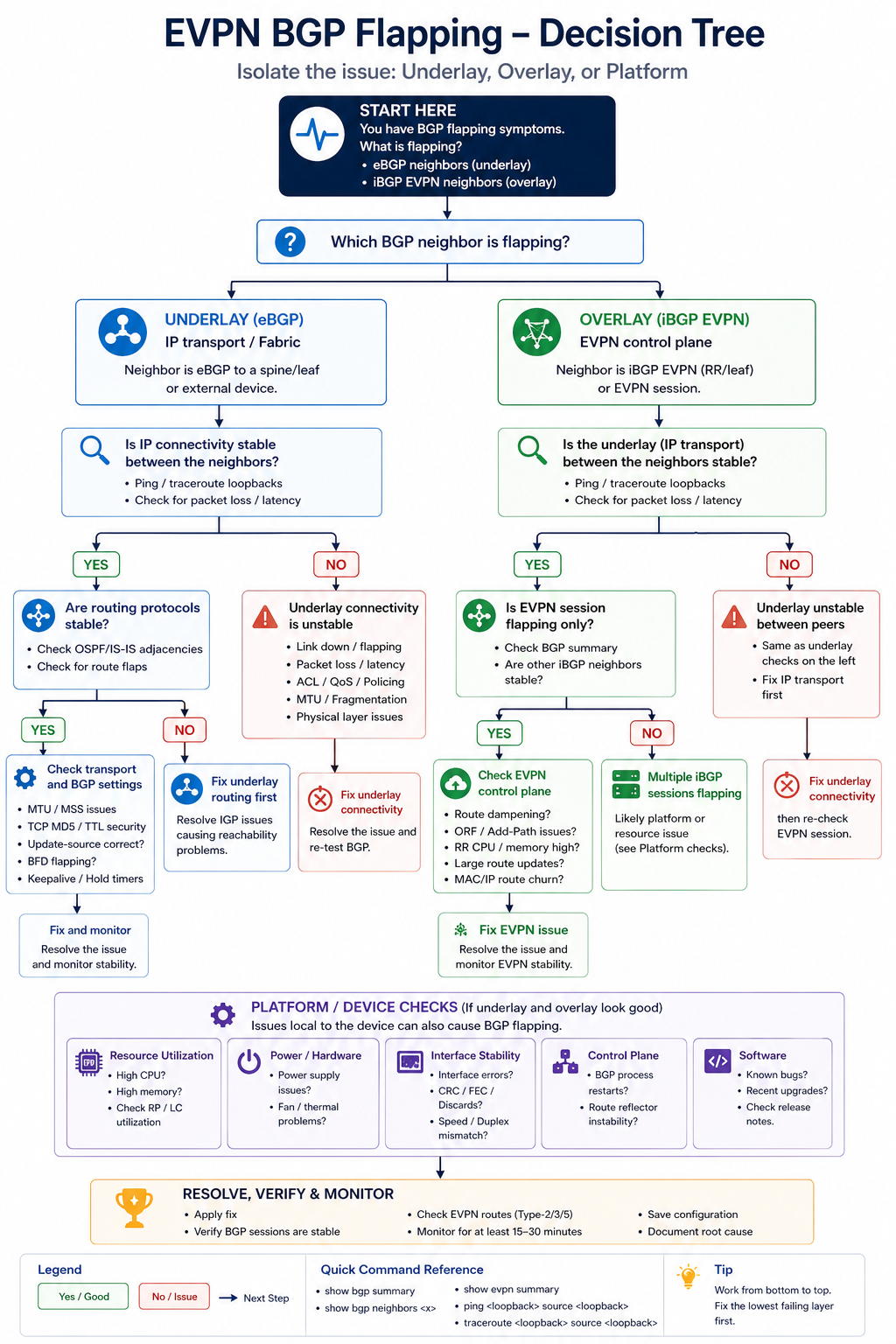
The short version. Always isolate underlay first. If the underlay BGP session between leaf and spine is unstable, the overlay sessions ride on top of that and look unstable too, but the root cause is one layer down. Spending an hour debugging EVPN AFI before you have confirmed the underlay is solid is one of the most common time-wasters in fabric operations. Walk the layers from physical, to underlay, to overlay, in that order, every time.
The two BGP sessions, briefly
In a typical EVPN-VXLAN fabric, every leaf has at least two BGP sessions to each spine. The first runs in the IPv4 unicast AFI (or IPv6) and carries the underlay reachability. The second runs in the L2VPN EVPN AFI and carries the overlay routes. The two sessions are independent at the protocol level but they ride on the same underlying TCP transport and physical interface. So a flap on the physical layer affects both.
The trick is that some causes affect only the underlay (a faulty interface), some affect only the overlay (an EVPN AFI configuration issue or an EVPN route-import policy that drops everything), and some affect both. Knowing which layer is unstable narrows the search space dramatically. The output of show bgp summary by AFI tells you instantly where the issue lives.
Diagnostic order
Step 1, physical and interface health
Before BGP, check the physical link. Interface error counters, CRC, input drops, optical light levels on the SFP. A spine-leaf link with marginal optics will produce BGP flaps that look like a routing issue but are actually a layer 1 issue. show interface counters errors on both sides. If anything is non-zero and growing, fix the physical layer first.
Step 2, underlay BGP session state
Run show bgp ipv4 unicast summary on the leaf and confirm the session to each spine is Established with a stable uptime. If uptime is short or oscillating, the underlay is unstable. Common causes: BGP timer mismatch, ACL blocking BGP TCP 179, MTU issue affecting BGP UPDATE messages.
Step 3, overlay (EVPN AFI) session state
Run show bgp l2vpn evpn summary. If the underlay is solid but EVPN is unstable, the issue is in the overlay layer. Possible causes: route-target import policies that conflict, EVPN-specific platform bugs, or excessive overlay route churn from an external trigger (e.g., MAC moves cascading from a dual-homed host).
Step 4, EVPN route table churn
Even with stable BGP sessions, EVPN can show symptoms of instability if specific routes are flapping rapidly. show bgp l2vpn evpn route-type 2 and look for MAC-IP routes that are constantly being withdrawn and re-advertised. This often points to a host that is moving rapidly between VTEPs (a misconfigured load balancer, a multi-homed host with poor LACP), or to a duplicate MAC somewhere in the fabric.
Step 5, MAC mobility events
EVPN’s MAC mobility extended community tracks how often a MAC has moved. show evpn mac route-type 2 detail and look for elevated mobility sequence numbers. If the same MAC is at sequence 50 after a few minutes, you have a host or device that is constantly being attributed to different VTEPs.
Step 6, platform CPU and process health
If everything above looks healthy and BGP still flaps, check leaf and spine CPU. Aggressive churn from another protocol, a flapping interface elsewhere, or a misbehaving streaming telemetry export can starve BGP of CPU and trigger keepalive misses. show processes cpu sorted and look at history.
Common patterns we see in production
Three patterns dominate in real fabrics. First, a single dual-homed host with bad LACP causes MAC mobility events that ripple through the EVPN AFI and create the appearance of fabric-wide flapping. Find the host, fix the LACP. Second, an MTU mismatch on a single spine-leaf link drops some BGP UPDATEs but not others, causing intermittent EVPN route disagreement between leaves. Third, a route-target import policy with a typo causes one leaf to fail to import EVPN routes from a specific tenant, which surfaces as black-holing in that tenant’s traffic but not as a BGP session flap. The third pattern is particularly insidious because show bgp summary looks fine.
What the vendor documentation does not tell you
Cisco, Arista, Juniper, and Nokia each implement EVPN with slight differences in how they handle MAC mobility, ESI labels, and route-target auto-derivation. Multi-vendor fabrics can produce flap-like behavior simply because different vendors interpret a corner case slightly differently. If you run a multi-vendor fabric, document the specific quirks of each vendor’s EVPN implementation in your runbook before the next incident.
Also, BFD is widely deployed for fast failure detection in fabrics, and BFD running too aggressively will declare a session down on a momentary CPU dip. If BGP is flapping with very fast hold-down times, check whether BFD configuration is more aggressive than the underlying platform can sustain.
The architectural fix
Stable EVPN fabrics share four traits. They use route reflectors or route servers to bound the BGP mesh complexity. They monitor underlay and overlay separately, with distinct dashboards and alert thresholds. They have a documented multi-vendor quirks file that captures every interop decision made during deployment. And they do not over-tune BFD or BGP timers without testing under load. Most fabric instability we encounter traces back to skipping one of these.
FAQ
Should I check underlay or overlay first?
Underlay first, always. Overlay sits on top of underlay TCP, so any underlay instability surfaces in overlay too. Confirming underlay is healthy isolates the search.
Is it ever the spines and not the leaves?
Sometimes, especially when one spine has a different software version or hardware generation than the other. Spine asymmetry is rare but real, and it causes very confusing flap patterns.
Will BGP graceful restart help?
For planned events like software upgrades, yes. For actual instability, no.
Related posts
Need help with a fabric incident
EVPN fabrics are unforgiving when something is off. Our data center practice operates and audits EVPN-VXLAN fabrics at scale and we are comfortable jumping into an active incident. Send us the topology and a sample of show output and we will help isolate.
Last verified April 2026 by the aaanetworkx data center practice.

How EVPN-VXLAN Powers Scalable, Multi-Tenant Data Center Networks
Modern data centers face relentless pressure, more workloads, more tenants, more east-west traffic, and the constant need to scale without complexity. If you are still running a traditional three-tier network or relying on VLANs and Spanning Tree, you have likely already hit those limits.
EVPN-VXLAN is the industry-standard answer. In this guide, we break down exactly how it works, why the leaf-spine topology is its natural partner, and how to choose between symmetric and asymmetric IRB for your environment.
Need help designing your data center fabric? Talk to our engineers →
Why Traditional Data Center Architectures Struggle at Scale
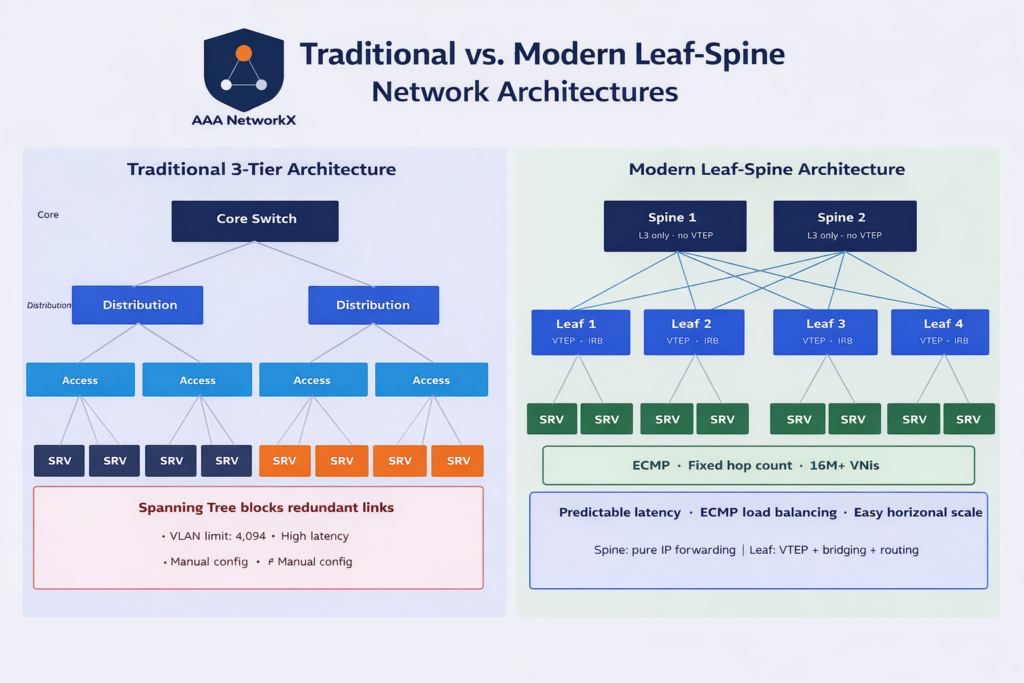
Traditional three-tier data center architectures (core–distribution–access) were engineered for a world dominated by north-south traffic, client-to-server flows. Today, that model is reversed. Modern cloud workloads generate massive east-west traffic between servers, containers, and microservices.
The result is a mismatch that shows up as real operational pain:
- VLAN exhaustion, the 802.1Q standard caps VLANs at 4,094. A large multi-tenant environment exhausts this in a single data center.
- Spanning Tree Protocol (STP) inefficiency, STP blocks redundant links, wastes bandwidth, and causes slow convergence during failures.
- Complex configuration, each change touches multiple devices, increasing human error and change windows.
- Poor fault isolation, a broadcast storm or loop in one VLAN can affect all tenants.
- Rigid workload mobility, in traditional setups, moving a Virtual Machine (VM) between hosts often requires complex VLAN extending, which is prone to configuration drift and network loops.
These are not edge cases. They are architectural constraints that limit how far traditional designs can scale.
What Is EVPN-VXLAN? (Control Plane + Data Plane Explained)
EVPN-VXLAN solves the scalability problem by cleanly separating two concerns:
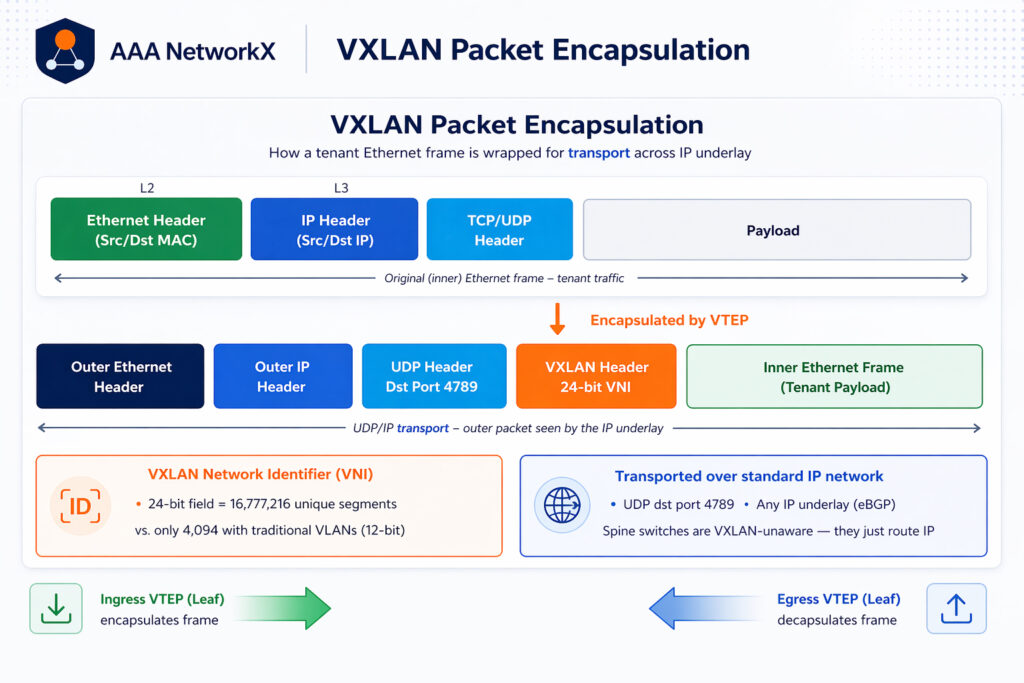
VXLAN handles the data plane. It encapsulates Layer 2 Ethernet frames inside UDP/IP packets, creating a logical overlay that stretches across any Layer 3 underlay. The key enabler is the 24-bit VXLAN Network Identifier (VNI), which supports over 16 million unique network segments, compared to the 4,094-segment VLAN ceiling.
EVPN handles the control plane. Instead of learning MAC addresses by flooding frames and observing replies (the traditional “flood-and-learn” method), EVPN uses Multi-Protocol BGP (MP-BGP) to distribute MAC and IP reachability information in a controlled, scalable way. This eliminates unnecessary broadcast traffic, speeds up convergence, and gives operators visibility into the network at all times.
Together, they give you a fabric that scales to hundreds of thousands of endpoints without the operational chaos of traditional designs.
Leaf-Spine Architecture: The Ideal Underlay for EVPN-VXLAN
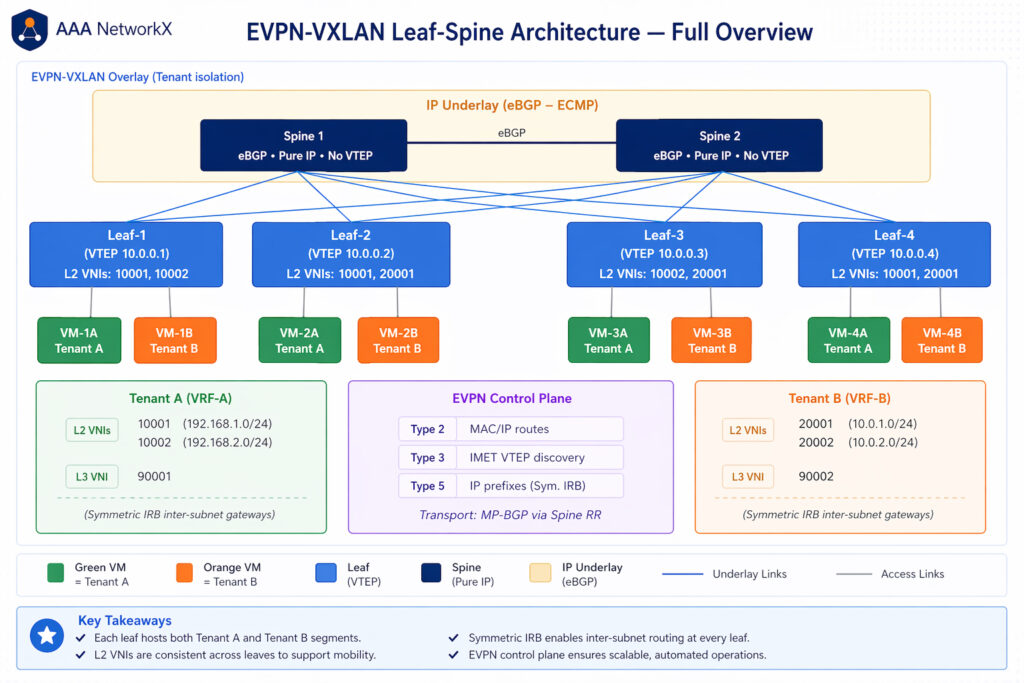
EVPN-VXLAN is almost always deployed on a leaf-spine topology, and for good reason. Leaf-spine provides:
- Predictable latency, any server-to-server path is always leaf → spine → leaf, giving you a fixed, consistent hop count.
- ECMP load balancing, multiple equal-cost paths are available simultaneously, distributing traffic and eliminating bottlenecks.
- Easy horizontal scaling, adding capacity means adding leaf switches, not redesigning the core.
Spine switches in this design focus purely on Layer 3 IP forwarding. They are not VXLAN-aware, they simply route IP packets between leaf nodes as fast as possible.
Leaf switches are where the intelligence lives. They act as VXLAN Tunnel Endpoints (VTEPs), encapsulating and decapsulating VXLAN traffic at the network edge. With Integrated Routing and Bridging (IRB) enabled, a leaf switch serves as both a Layer 2 bridge for intra-subnet traffic and a Layer 3 gateway for inter-subnet traffic, all within the same tenant VRF.
The design separates the underlay (a simple eBGP-routed IP network that moves packets between VTEPs) from the overlay (EVPN-VXLAN, which carries tenant traffic and enforces isolation). This separation makes troubleshooting dramatically easier, underlay problems are IP routing problems; overlay problems are EVPN problems.
EVPN Route Types That Make It Work
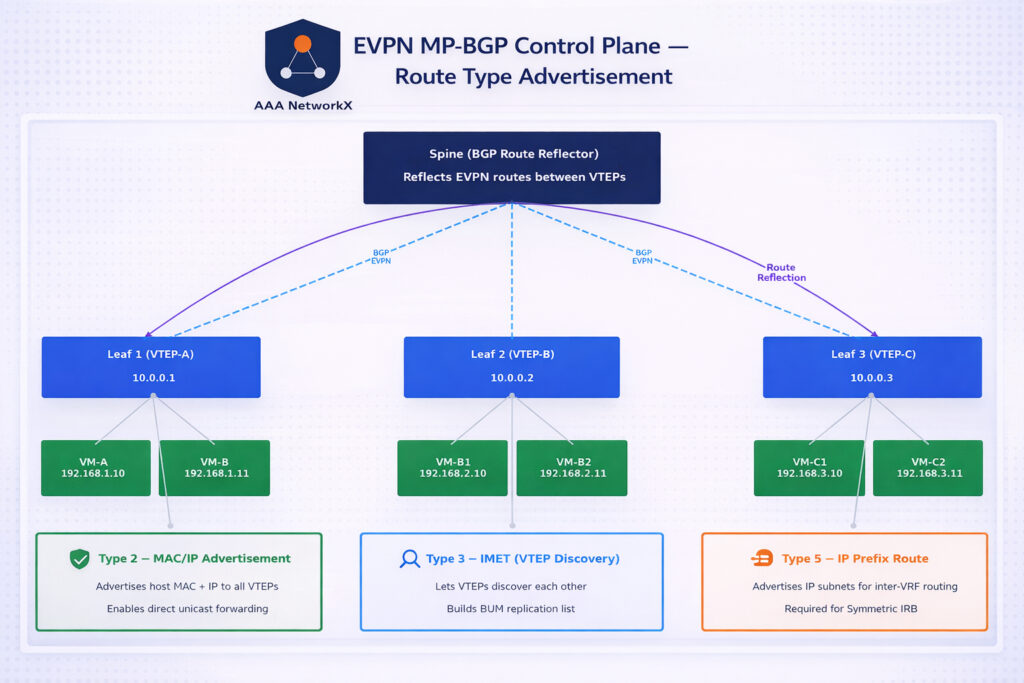
EVPN uses different BGP route types, each serving a specific purpose:
| Route Type | Purpose |
|---|---|
| Type 2 (MAC/IP Advertisement) | Advertises a host’s MAC address and IP address to all VTEPs so they can forward traffic directly without flooding |
| Type 3 (Inclusive Multicast Ethernet Tag / IMET) | Allows VTEPs to discover each other and build BUM (Broadcast, Unknown unicast, Multicast) replication lists |
| Type 5 (IP Prefix Route) | Advertises IP prefixes into the fabric for inter-subnet routing; essential for symmetric IRB |
In practice, Type 2 handles known unicast traffic, Type 3 bootstraps the fabric, and Type 5 enables tenant routing to scale across the fabric.
Symmetric IRB vs. Asymmetric IRB: Which Should You Use?
When traffic must cross subnets within a tenant (inter-subnet routing), the leaf switch performs Integrated Routing and Bridging (IRB). There are two models:
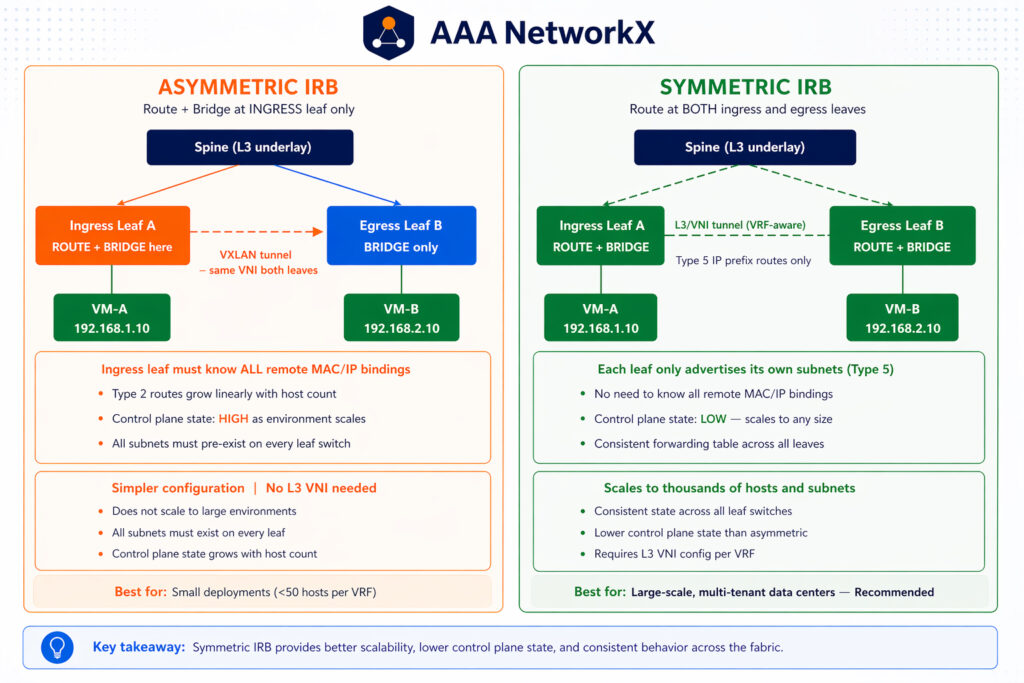
Asymmetric IRB
The ingress leaf performs both routing and bridging in one step. The egress leaf only bridges. This is simpler to configure, but it requires the ingress leaf to hold MAC/IP bindings for every host across all remote subnets, control plane state that grows linearly with host count.
Best for: Small to medium deployments with limited subnet counts.
Symmetric IRB
Both ingress and egress leaves perform routing. An additional Layer 3 VNI carries the traffic between them, and Type 5 routes advertise IP prefixes rather than individual host routes. Control plane state is much lower because each VTEP only needs to know about its directly attached subnets.
Best for: Large-scale, multi-tenant environments, the recommended approach for most enterprise and cloud data centers.
Summary: If you are building for scale, use symmetric IRB. The operational overhead of managing per-host state in asymmetric mode quickly outweighs its initial simplicity.
Have questions about symmetric vs. asymmetric IRB for your environment? Talk to an AAANetworkX engineer →
Key Benefits of EVPN-VXLAN for Enterprise and Cloud Data Centers
| Benefit | How EVPN-VXLAN Delivers It |
|---|---|
| Scalability | 24-bit VNIs support 16M+ segments; distributed routing avoids centralized bottlenecks |
| Multi-tenancy | VRFs provide per-tenant routing tables; VNIs enforce data plane isolation |
| High Availability | ECMP across multiple spine paths; fast BGP convergence on failure |
| Operational Simplicity | Control plane learning eliminates flooding; centralized BGP visibility |
| Vendor Interoperability | Open standards (BGP, VXLAN) work across Cisco, Juniper, Arista, Nokia, and others |
EVPN-VXLAN vs. Traditional VLAN and MPLS
| Feature | Traditional VLAN | MPLS | EVPN-VXLAN |
|---|---|---|---|
| Scale | 4,094 segments | High | 16M+ segments |
| Control Plane | Flood-and-learn / STP | LDP / RSVP | MP-BGP |
| Deployment Complexity | Low (but operationally painful at scale) | High | Moderate |
| Cloud/Data Center Fit | Poor | Poor | Excellent |
| Multi-tenancy | Limited | Yes (with L3VPN) | Yes (VRF + VNI) |
EVPN-VXLAN fills the gap between the simplicity of VLANs and the power of MPLS, without requiring a dedicated MPLS transport infrastructure.
Ready to Build a Scalable Data Center Network?
At AAANetworkX, we design and implement modern data center fabrics for enterprises and service providers. Whether you are evaluating EVPN-VXLAN for the first time or planning a migration from a traditional three-tier design, our team can help.
Contact AAANetworkX for a free consultation →
Read next: SD-WAN Explained, Connecting Your Sites to the Cloud →