Cybersecurity Edmonton accounting firms need is sharpened by tax season risk concentration and the way CRA filing windows shape phishing patterns.
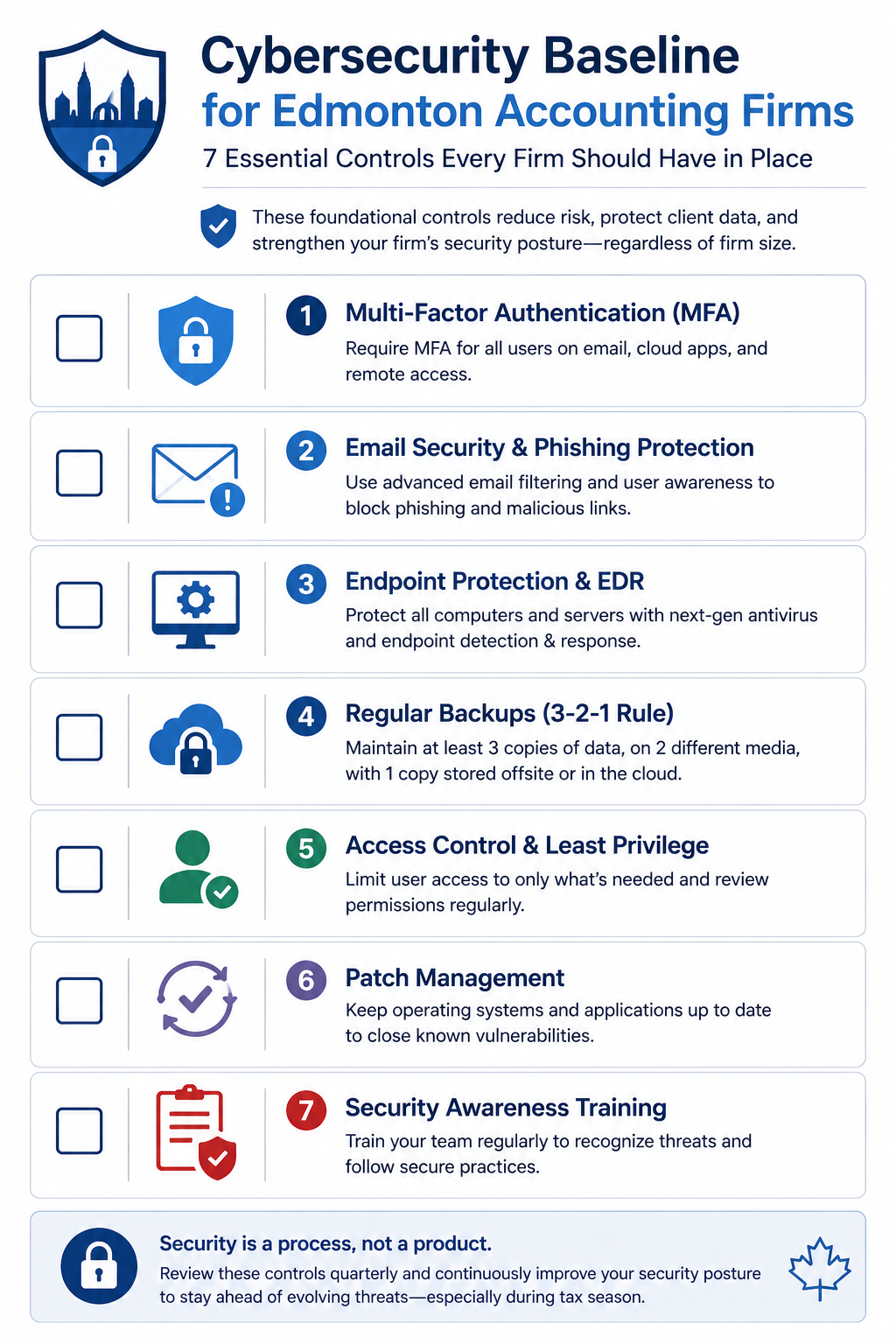
If you run an accounting firm in Edmonton, the data you hold is some of the most sensitive in the city. Tax filings, financial statements, payroll records, business succession plans, personal SINs, banking details. Attackers know this. Tax season specifically. Every year between January and May, accounting firms in Western Canada see a measurable spike in phishing, business email compromise, and ransomware attempts. This post walks through what cybersecurity actually means for an Edmonton accounting practice in 2026, what reasonable looks like, and what it should cost.
The short version. Accounting firms are uniquely targeted because attackers correctly assume the data has high resale value, the firm has time pressure during tax season, and clients will pay to keep filings on schedule. The good news is that the controls that actually stop the attacks are well understood and within budget. The harder work is consistency, especially during the months when staff are working late and clicking faster than they should.
Why accounting firms specifically
Three things make accounting firms unusually attractive to attackers compared to other professional services.
First, the data is high-value across multiple categories. Personal tax data, corporate financial data, banking records, payroll for client companies. A single firm compromise can yield thousands of personal records and dozens of corporate balance sheets. That data sells well on dark web markets and provides leverage for further targeted attacks against your clients.
Second, business email compromise targeting accounting firms has been on the rise. Attackers monitor email for invoice approvals, then send a perfectly timed fake instruction redirecting the payment to their account. We have seen Alberta firms lose between $30,000 and $400,000 to single incidents. The attacker often impersonates a known client.
Third, tax season creates time pressure that increases human error. Late nights, faster decisions, more clicks on emails that look urgent. Attackers know this and time their campaigns to tax season specifically.
What Edmonton accounting firms need
CPA Alberta and CPA Canada have been raising expectations around technology competence and client confidentiality. The CPA Code of Professional Conduct includes confidentiality obligations that extend to electronic data. PIPA adds breach notification timelines for personal information. CRA’s Mandatory Disclosure Rules and audit support obligations add their own data retention and access expectations.
None of these prescribe specific tools. They prescribe outcomes. So the question for a partner is not “what does my regulator require?” but “what controls would I be embarrassed to be missing if a breach happened tomorrow?”
The baseline
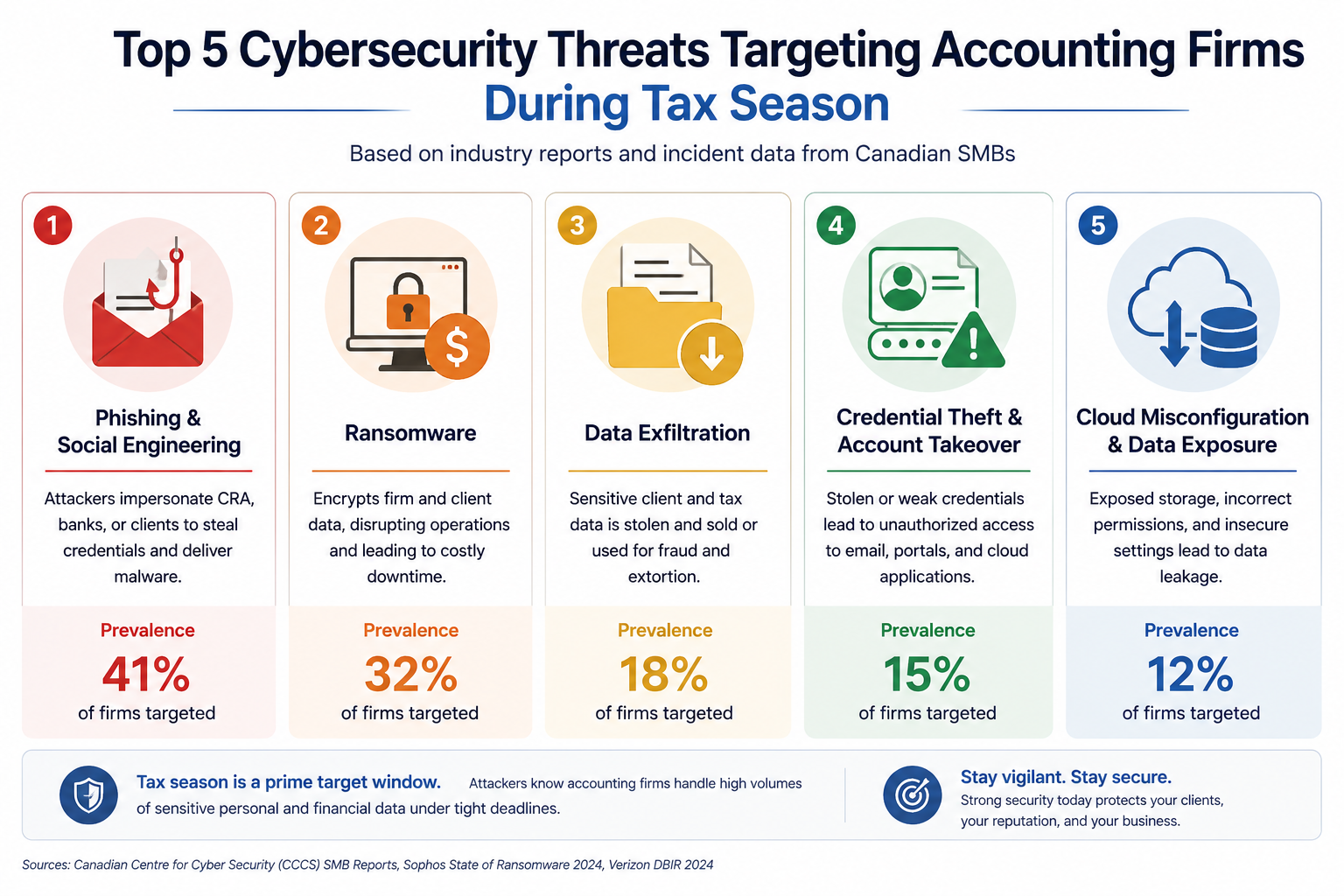
1. MFA on every account
The single highest impact control. Microsoft 365, accounting software (CaseWare, TaxCycle, Profile, etc.), banking portals, remote access. No exceptions for senior partners. Attackers know exactly which accounts are excluded.
2. EDR on every device
Microsoft Defender for Endpoint, SentinelOne, or CrowdStrike. Detects ransomware in progress and stops it before it spreads. Every laptop, every desktop, every server. Including the laptop the senior partner takes home.
3. Email security gateway with link sandboxing
Native M365 email security is good but not enough during tax season. Add a layer that opens every link in a sandbox before delivery and that flags BEC patterns. This is the single biggest defense against the impersonation attacks targeting your firm during deadline weeks.
4. Daily encrypted backups with offsite copy
Tested quarterly. Untested backups have failed at the worst possible moment for at least three Alberta accounting firms I know of, including during tax season.
5. Written incident response plan
Two pages. Who calls who, what gets disconnected, who notifies clients, who notifies CPA Alberta and CRA if applicable, where the offline backups live. Written before the incident, not during.
6. Annual phishing simulation
Send a simulated phishing email to every staff member. Train the people who click. Make it slightly harder during tax season since that is when real attacks intensify.
7. Vendor and client portal hygiene
If you use a client portal for document exchange, audit it. Confirm MFA is enforced, access is removed when client engagements end, and uploads are scanned. The same for any practice management or tax software portal that staff log into externally.
What it actually costs
For a 10 to 30 person Edmonton accounting practice, the entire baseline runs roughly $90 to $160 per user per month, all in. That covers M365 Business Premium licensing, EDR, email security, backup tooling, and the managed service relationship to run the phishing simulation, quarterly access review, and tax season hardening for you.
Compare to incident cost. The most recent IBM Cost of a Data Breach Report puts financial services around USD 5.9 million globally. For an Alberta accounting firm, real-world incidents we have seen range from $25,000 (small firm, paid ransom plus recovery) to over $300,000 (mid-sized firm, did not pay, took five weeks to recover, lost three clients). None of those numbers include reputational damage or potential CPA Alberta complaints.
What we see firms get wrong
Three patterns repeat. First, partial deployments. MFA on most accounts, EDR on most laptops. The gap is always where the attacker enters. Second, the IT generalist trap. Many firms rely on a friendly local IT generalist who is good at fixing printers but has never investigated a breach. Cybersecurity is a different skill set. Third, tax season fatigue. Controls get bypassed in March because someone wanted to move faster. The bypass becomes permanent. Schedule a review of all temporary exceptions every May.
FAQ
Does cyber insurance cover ransomware payments for accounting firms?
Sometimes, but coverage has tightened. Most insurers require evidence of MFA, EDR, and tested backups before quoting, and many exclude ransomware payments entirely if those controls are missing.
Are cloud-based accounting platforms (Xero, QBO, etc.) safer?
The platform handles its own infrastructure security. Your accounts on it are still your responsibility. MFA, access reviews, and the controls above all still apply.
How quickly can a baseline be implemented before tax season?
For a firm starting near zero, the full baseline takes 30 to 45 days. Start in November or December for next tax season. Starting in February is too late.
Related posts
- Cybersecurity for Edmonton Law Firms
- PCI-DSS for Edmonton Retail WiFi
- Managed IT Edmonton Dental Practices
If you are a partner reading this
Tax season is six months away. Now is the right time to assess where your firm stands. Our team works with several Edmonton accounting practices and we can do a focused 90 minute assessment that produces a one-page priority list, no commitment.
Book a free 90 minute cybersecurity assessment for your accounting firm. We will come to your office, walk through the seven controls above with whoever you want in the room, and leave you with a written priority list.
Last verified April 2026 by the aaanetworkx cybersecurity practice. Edmonton, Alberta.