
Managed IT Edmonton medical clinics need is shaped by EMR systems, imaging integration, PHIPA compliance, and the clinical workflow that cannot pause for IT issues.
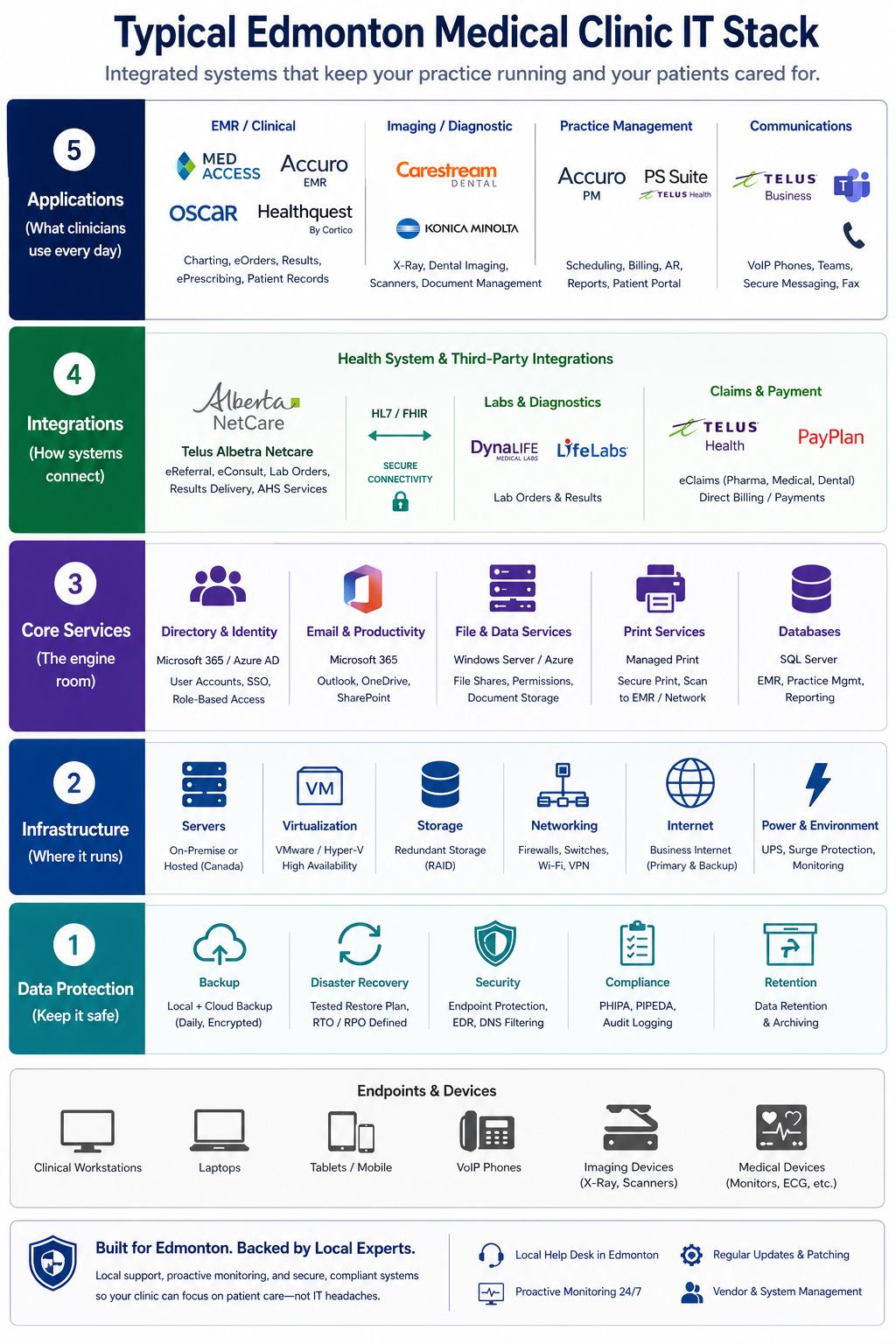
Running a medical clinic in Edmonton means balancing patient care, billing, regulatory compliance, and an IT stack that has to be available every minute the clinic is open. EMR systems, imaging integration, AlbertaNetCare connections, claims processing. When something breaks, it costs patient time and clinic revenue immediately. This post walks through what managed IT for an Edmonton medical clinic actually involves in 2026, what reliable looks like, and what it should cost.
The short version. Medical clinics have a uniquely demanding IT stack relative to clinic size, with regulatory weight (PIPA, PHIPA-equivalent expectations under the Health Information Act, College of Physicians and Surgeons of Alberta privacy obligations) layered on top. The clinics with reliable IT in Edmonton work with providers who understand both the EMR vendor ecosystem and the regulatory environment. Generic IT support typically does not.
Why medical is different from generic small business IT
The IT stack at a 4 to 6 physician medical clinic is more complex than the stack at a 30 person law firm. Three reasons.
First, EMR integration with provincial systems. Alberta’s NetCare connectivity, Pharmaceutical Information Network, and lab interface integrations all need to work, every day, with strict authentication and audit requirements. When NetCare integration breaks, physicians cannot review patient history at the point of care. Generic IT does not understand these integrations.
Second, imaging and device interoperability. Digital X-ray, ultrasound machines, ECG, dermatoscopes, and increasingly IoT-enabled vitals monitors all need to connect to the EMR or a separate PACS, often through legacy interfaces. Each device update can break compatibility silently.
Third, regulatory weight. The Health Information Act, the College of Physicians and Surgeons of Alberta privacy expectations, and PIPA all apply. Breach reporting timelines are short. Audit logs are expected. Custodian responsibilities are explicit. The integration is what separates reliable from frustrating.
What we see practices get wrong
Five patterns repeat across Edmonton medical clinics we have audited. First, no offsite backup of EMR data, so a fire or ransomware would lose patient records. Second, NetCare authentication tokens stored insecurely (sometimes in shared text files, sometimes embedded in browser shortcuts). Third, password sharing among nursing staff because the EMR vendor charges per seat. Fourth, the front desk computer is also the patient communication terminal, the imaging review station, and the staff browsing machine, all on the same Windows account. Fifth, no incident response plan, so when ransomware hits a clinic (and it does hit clinics regularly), staff makes decisions in panic during patient hours.
What reliable looks like
EMR uptime and integrity
The EMR (server-based or cloud-connected) is monitored continuously. Backups every 4 hours during clinic hours, every 24 hours overnight, with offsite copies retained for at least one year. Restore tested quarterly. Vendor support contact documented and tested annually.
NetCare and provincial integrations tested after every change
Whenever the EMR updates, Windows updates, or NetCare changes, a test login and patient lookup is performed before the clinic opens. This catches integration issues before patients arrive.
Per-user accounts with strong authentication
Every staff member has their own login. MFA on Microsoft 365, on the EMR, on NetCare, on remote access. The cost of additional licenses is far less than the cost of one ransomware incident or one privacy breach.
Cybersecurity baseline
EDR on every device. Email security gateway. Encrypted backups with offsite copies and tested restore. Phishing simulation. Incident response plan written down. The same baseline that legal, accounting, and dental practices need, with healthcare-specific tweaks for breach reporting timelines.
Vendor management
One IT provider takes ownership of coordinating with the EMR vendor, imaging vendor, lab interface vendor, and ISP when something breaks across systems. The physician does not have to be the one calling each vendor.
PHIPA and Health Information Act readiness
Audit logs retained per regulatory expectation (typically 10 years for clinical records). Privacy impact assessment refreshed when new tech is added. Custodian responsibilities documented. Breach response procedure rehearsed annually.
What it actually costs
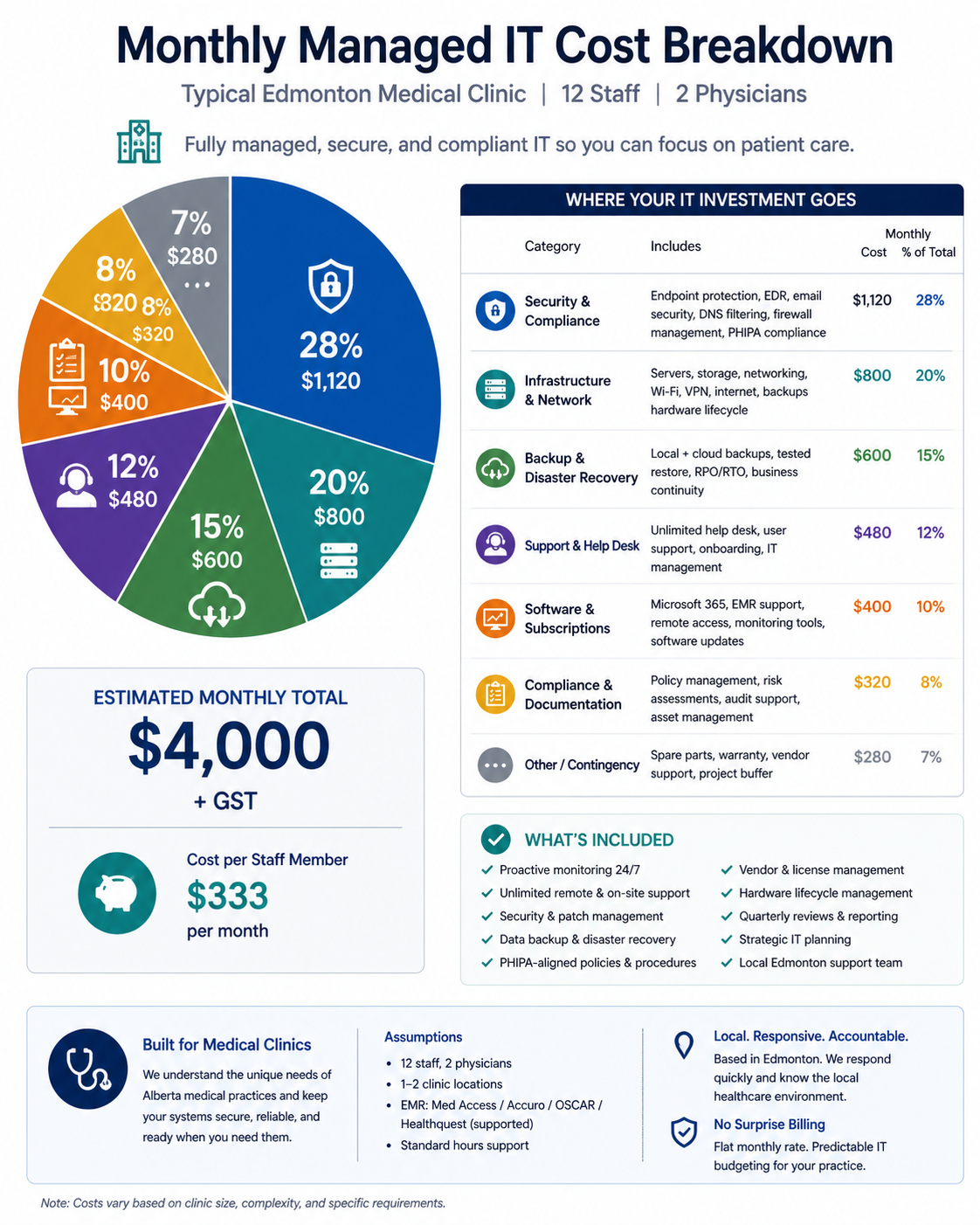
For a typical Edmonton medical clinic with 8 to 16 staff and 3 to 6 physicians, fully managed IT including the cybersecurity baseline runs roughly $160 to $245 per user per month. That covers M365 Business Premium, EDR, email security, backup tooling, helpdesk and on-site support, EMR vendor coordination, NetCare integration support, monitoring of the EMR server, and quarterly compliance check-ins.
Compare to outage cost. A four hour EMR outage at a 4 physician clinic typically loses $5,000 to $12,000 in productive time. A ransomware incident on a clinic that does not have tested backups can run $80,000 to $300,000. None of those numbers include the College complaint risk if patient information is exposed.
FAQ
Do you support Med Access, Accuro, OSCAR, Healthquest?
Yes. We have Edmonton clients on each. Integration test scripts catch most update breakage before patients arrive.
What about cloud-hosted EMR?
Cloud EMR reduces local server complexity but increases dependence on internet uptime. We help clinics size redundant internet (cable + cellular failover) and harden the network so cloud EMR is reliable.
Is co-managed possible for a clinic?
Yes. Many clinics keep an internal IT generalist and use us for EMR coordination, security tooling, backup, and compliance. Co-managed works well in healthcare.
Related posts
- Managed IT Edmonton Dental Practices
- HIPAA Network Segmentation Requirements
- Cybersecurity for Edmonton Law Firms
If you are a physician or practice owner reading this
You probably already know whether your IT is reliable or just barely working. We do focused 60 minute walkthroughs that produce a one page priority list, no commitment.
Book a free 60 minute IT assessment for your clinic. We will come to your office, walk through the systems with whoever you want in the room, and leave you with a written priority list.
Last verified April 2026 by the aaanetworkx managed IT practice. Edmonton, Alberta.