
Traditional WAN vs SD-WAN: What’s the Difference and Why It Matters for Your Business
Network connectivity is the foundation of everything modern businesses do, from accessing cloud applications and supporting remote workers to connecting dozens of branch offices across the country. When the network underperforms, everything suffers.
For decades, organizations depended on Traditional WAN, primarily MPLS circuits, to link their locations together. It was reliable, but it was also expensive, rigid, and increasingly mismatched with how businesses operate today.
SD-WAN (Software-Defined Wide Area Network) changes the equation. It delivers the performance and reliability businesses need, at a fraction of the cost, with far greater flexibility. In this guide, we break down exactly how the two approaches compare and what that means for your organization.
Thinking about SD-WAN? Talk to an AAANetworkX engineer →
The Problem with Traditional WAN in a Cloud-First World
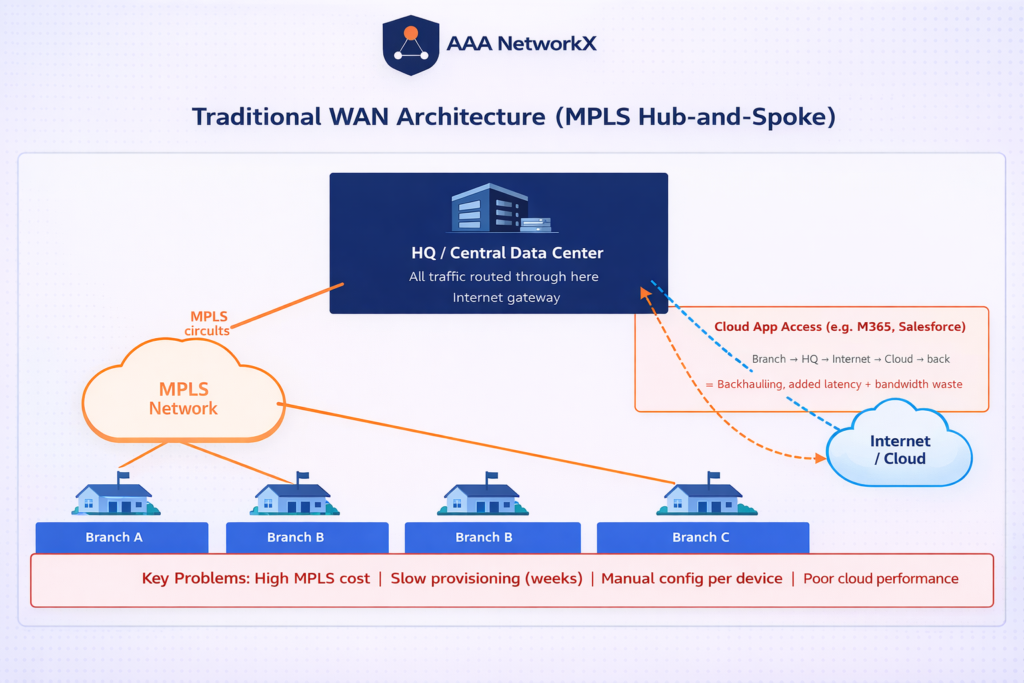
Traditional WAN was built for a different era, one where applications lived in a central data center and users sat in fixed office locations. In that world, dedicating a private MPLS circuit to each branch made sense.
Today, that world no longer exists for most organizations.
MPLS Is Reliable, But It’s Expensive and Inflexible
MPLS (Multiprotocol Label Switching) delivers consistent, low-latency connectivity. But it comes with significant tradeoffs:
- High cost, dedicated MPLS circuits are expensive to provision and maintain, especially across many locations
- Long lead times, adding a new branch can take weeks or months of provisioning time
- Locked to a single provider, MPLS contracts typically tie you to one carrier, limiting negotiating power
The Backhauling Problem: Why Cloud Apps Suffer on Traditional WAN
One of the biggest performance killers in traditional WAN is backhauling. When a branch office user needs to access Microsoft 365, Salesforce, or any other cloud application, their traffic often travels all the way to a central data center first, then out to the internet, and back again.
This indirect route adds latency, degrades application performance, and creates unnecessary load on the central site. As cloud adoption accelerates, this problem compounds.
Manual Configuration and the Scalability Wall
Traditional WAN is fundamentally hardware-centric. Every router at every branch must be configured manually. Deploying a new site, pushing a policy change, or responding to a network issue requires touching individual devices, one at a time. As branch count grows, the operational burden grows with it.
What Is SD-WAN? A Plain-English Explanation
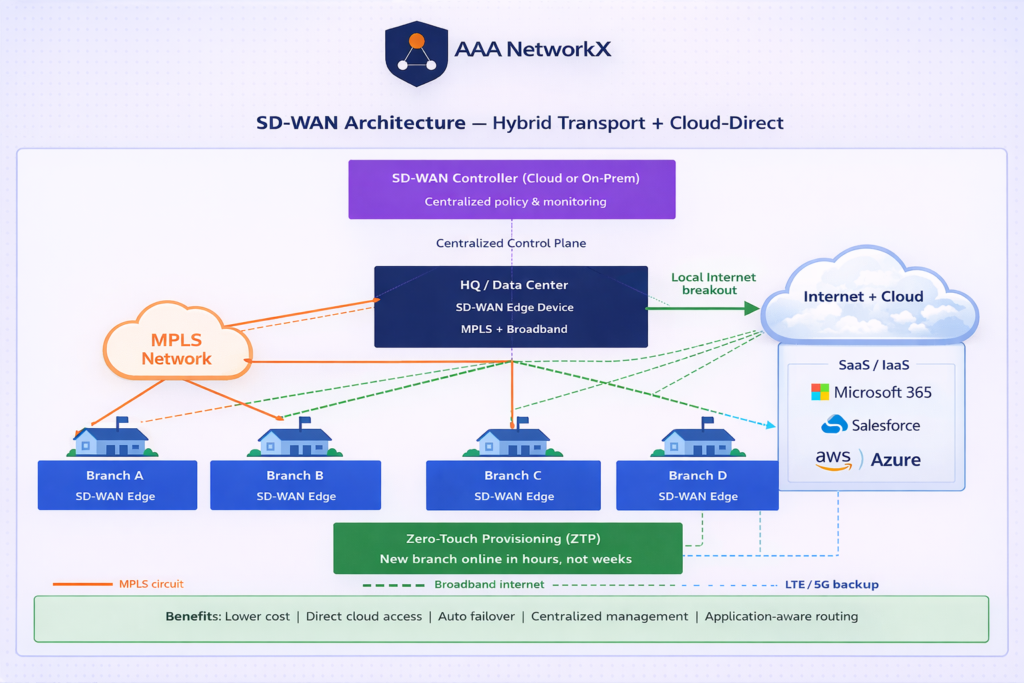
Software-Defined Wide Area Network (SD-WAN) decouples the network control plane from the hardware. Instead of configuring individual routers, network policies are defined centrally, in software, and automatically pushed to all locations.
Software-Defined, Centrally Managed
A single SD-WAN controller gives IT teams a unified view of the entire WAN. Policies, routing rules, security settings, and application priorities are managed from one place and applied consistently across all sites, whether you have 5 branches or 500.
Multiple Transport Options: MPLS, Broadband, LTE
SD-WAN is transport-agnostic. It can use MPLS, broadband internet, LTE/5G, or any combination of these simultaneously. This is called a hybrid WAN approach, you get the reliability of MPLS where you need it and the cost efficiency of broadband where it makes sense.
Application-Aware Routing: The Right Path for Every App
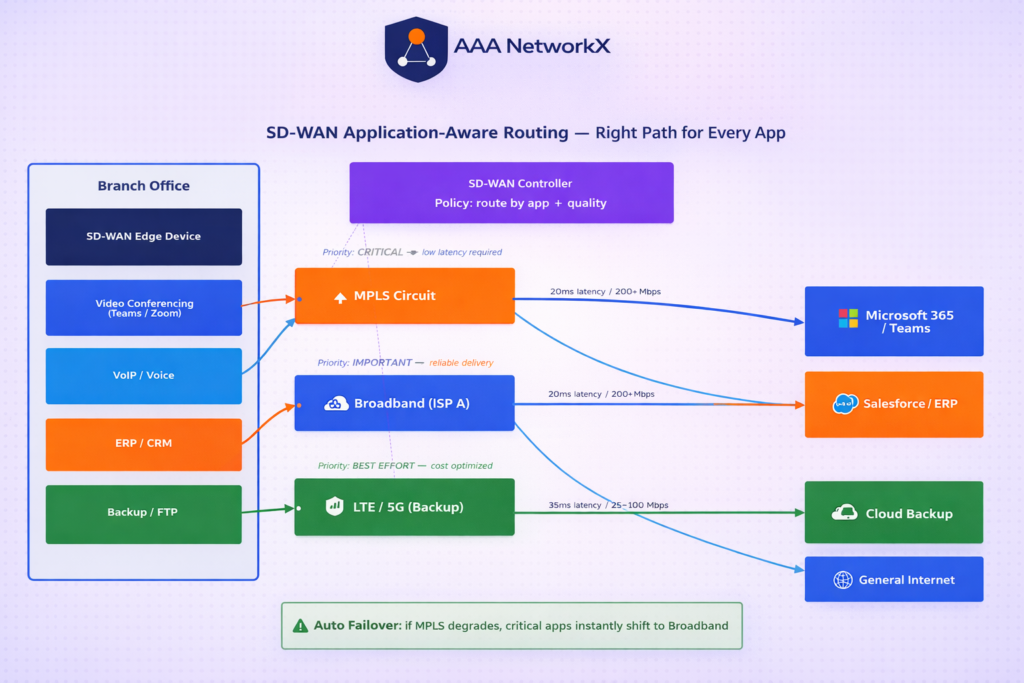
This is where SD-WAN delivers its most tangible value. SD-WAN continuously monitors the quality of each available link (latency, jitter, packet loss) and routes traffic based on application requirements:
- Video conferencing and VoIP get low-latency, high-reliability paths
- Bulk data transfers use cheaper broadband links
- If one path degrades or fails, traffic automatically shifts to the best available alternative, with no human intervention required
Traditional WAN vs SD-WAN: Side-by-Side Comparison
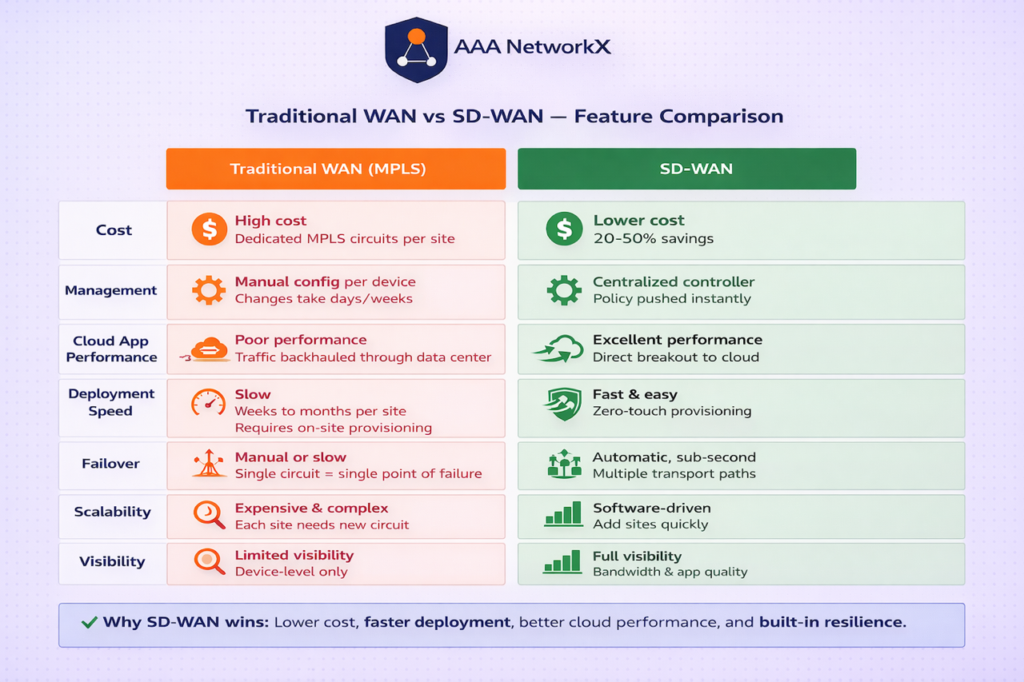
| Feature | Traditional WAN (MPLS) | SD-WAN |
|---|---|---|
| Cost | High (dedicated circuits) | Lower (leverages internet/LTE) |
| Management | Manual, per-device | Centralized, policy-driven |
| Cloud App Performance | Poor (backhauling) | Excellent (direct breakout) |
| Deployment Speed | Weeks to months | Hours to days |
| Scalability | Complex and expensive | Simple, software-driven |
| Transport Flexibility | MPLS only | MPLS + broadband + LTE |
| Visibility | Limited | Full application-level visibility |
| Failover | Manual or slow | Automatic, sub-second |
Why Businesses Are Migrating to SD-WAN
Faster Branch Rollouts
With SD-WAN, deploying a new branch is a software operation. A device arrives at the new site, connects to the internet, and automatically downloads its configuration from the controller, a process called zero-touch provisioning (ZTP). What used to take weeks now takes hours.
Automatic Failover and Path Selection
SD-WAN monitors link quality continuously. If an MPLS circuit goes down or becomes congested, SD-WAN instantly reroutes traffic through the best available alternative, broadband, LTE, or another MPLS circuit. End users typically experience no interruption.
Significant Cost Reduction
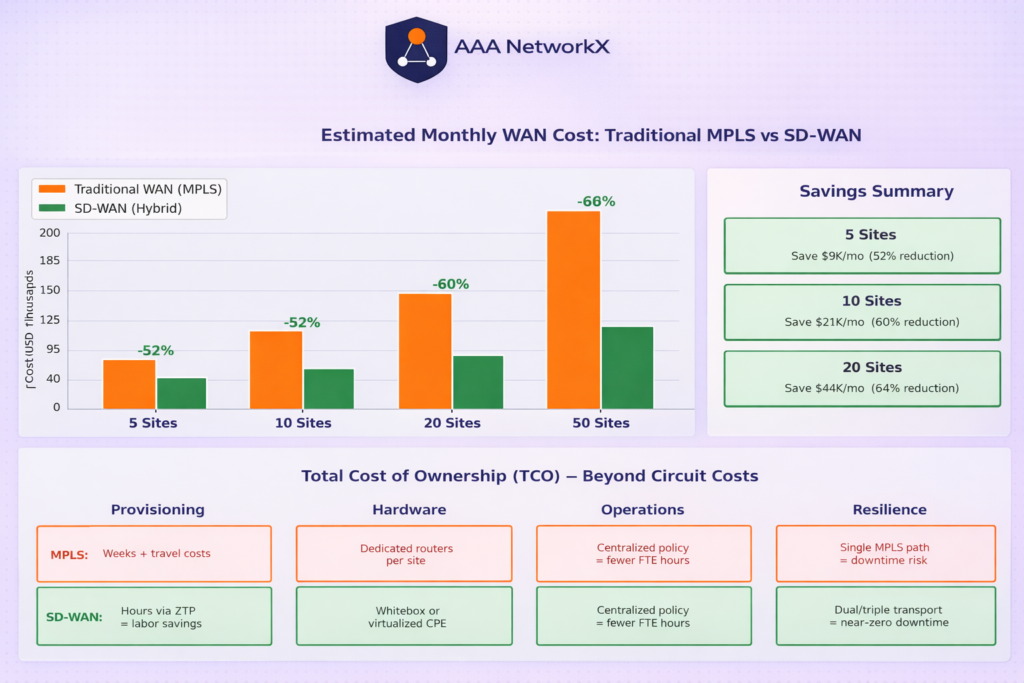
By supplementing or partially replacing expensive MPLS circuits with lower-cost broadband connections, organizations commonly achieve 20–50% WAN cost reductions while maintaining or improving performance.
Better Visibility and Control
Traditional WAN offers limited insight into what is happening on the network. SD-WAN provides application-level visibility, you can see exactly which applications are running, how much bandwidth they consume, and how each link is performing. This makes capacity planning and troubleshooting dramatically easier.
Is SD-WAN Right for Your Organization?
SD-WAN delivers the strongest ROI for organizations that:
- Have multiple branch offices or remote sites
- Are heavily using cloud applications (Microsoft 365, Google Workspace, Salesforce, etc.)
- Are experiencing high WAN costs from MPLS-only infrastructure
- Need to scale quickly without proportional increases in IT effort
- Require better visibility and control over application performance
If you are running a single-site operation with minimal cloud usage, traditional WAN may still be sufficient. But for most modern enterprises, SD-WAN is not just an upgrade, it is a necessity.
Ready to assess your WAN? Talk to an AAANetworkX engineer →
Modernize Your Network with AAANetworkX
At AAANetworkX, we help businesses design, deploy, and manage SD-WAN solutions tailored to their specific needs. Whether you are evaluating SD-WAN for the first time, planning a migration from MPLS, or looking to optimize an existing SD-WAN deployment, our certified network engineers are here to help.
Get a free SD-WAN assessment →
Read next: How EVPN-VXLAN Powers Scalable Data Center Networks →